

Written by James BrittTechnically reviewed by Jim Freeze · Reviewed
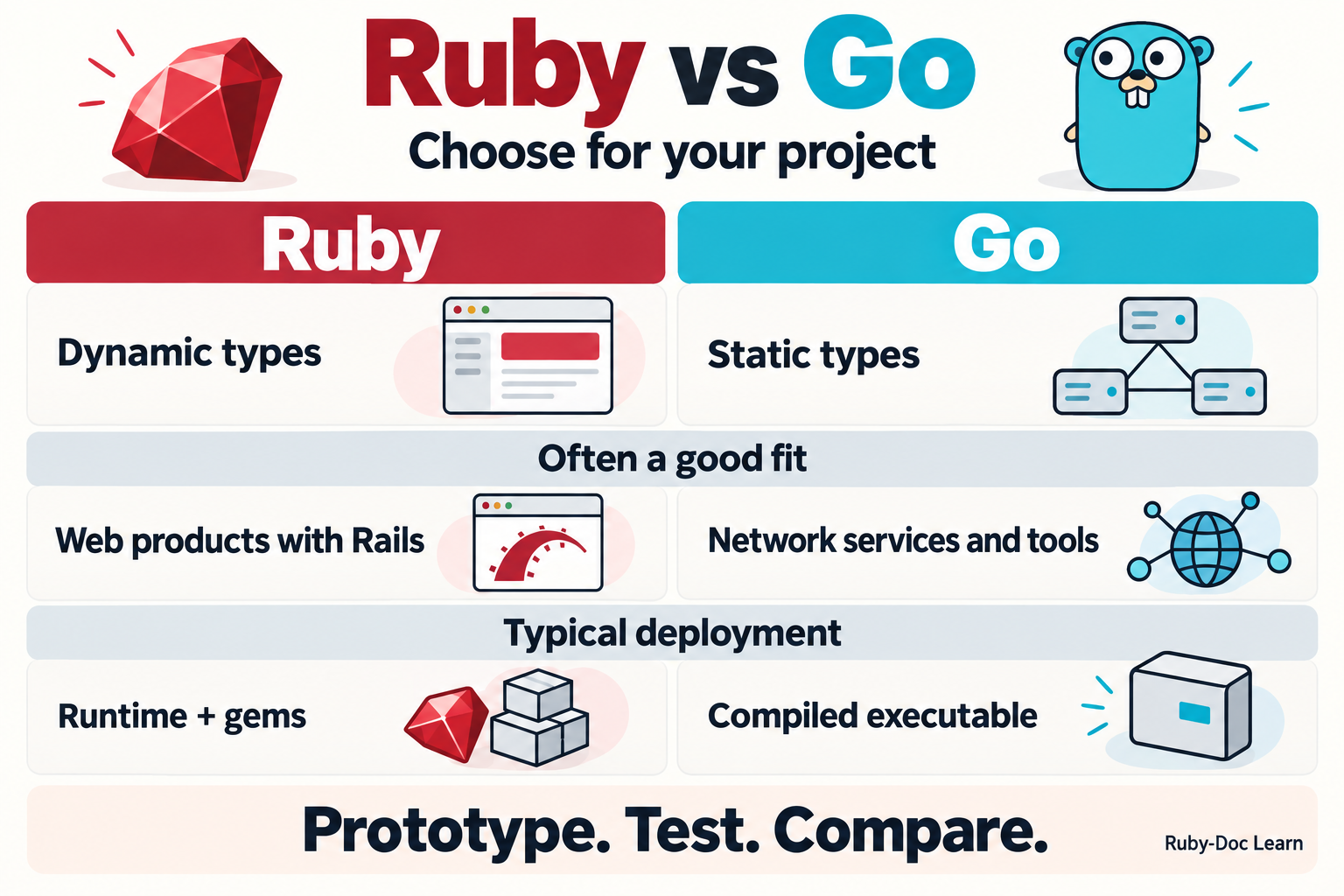
Ruby vs Go comes down to the application you need to build. Ruby and Rails often suit web products with substantial database workflows. Go is worth considering for network services and compiled command-line tools. First, assess your workload, team skills and deployment process. The best choice depends on the project.
A booking service and a busy network proxy have different demands. Both need to be reliable, of course. However, the path to that reliability can differ considerably. A popularity chart will tell you little about which stack helps your team finish the job.
Ruby vs Go at a glance
Ruby is primarily a dynamic, object-oriented programming language. Go, or Golang, uses static types and compiles programs. Both provide automatic memory management and support web development. Their tools, however, encourage somewhat different working habits.
| Question | Ruby | Go |
|---|---|---|
| Type checking | Primarily at runtime; optional tools add static checks | Built-in checks during compilation |
| Web development | Rails supplies an integrated application framework | Standard HTTP tools plus a choice of libraries |
| Concurrency | Threads, fibers, processes and Ractors; behavior depends on runtime | Goroutines and channels supported by the runtime |
| Deployment | Usually an application plus a Ruby runtime and gems | Often an executable built for the target platform |
| Common attraction | Expressive code and productive application development | Explicit code, built-in tooling and compiled services |
Again, these are starting points for each language. Ruby can create APIs and system tools; likewise, Go can run a complete web application. How much work does each ecosystem remove from your project? That is the more useful question.
Ruby vs Go syntax: compare a small task
Take a small task: select scores of at least 80, then print them on one line. Ruby handles the selection with a collection operation. On the other hand, the Go example uses a typed slice and an explicit loop.
Ruby example
scores = [72, 92, 65, 88]
cutoff = 80
selected = scores.select { |score| score >= cutoff }
puts selected.join(", ")
Go example
package main

import (
	"fmt"
	"strconv"
	"strings"
)

func main() {
	scores := []int{72, 92, 65, 88}
	cutoff := 80
	selected := []string{}
	for _, score := range scores {
		if score >= cutoff {
			selected = append(selected, strconv.Itoa(score))
		}
	}
	fmt.Println(strings.Join(selected, ", "))
}
Predict the output, then open the answer
Both examples print the same line:
92, 88Ruby selects matching values and joins their text representations. Go converts matching values to strings, appends them to a slice and joins them. Change the cutoff from 80 to 90: only 92 remains. With a cutoff of 100, both examples print an empty line.
Therefore, Ruby requires less setup here. Go exposes the types and transformations, which may help when this function joins a larger program. However, neither snippet tells you which language will make a whole application easier to maintain.
For more practice, try our Ruby code examples for beginners. Change the inputs, predict the results and explain each line before moving on.
Ruby vs Go for web development
When a product revolves around a database, compare the complete stacks. Rails supplies conventions for routing, database models, migrations, views and tests. Thus, a team familiar with Rails may spend less time selecting and connecting separate components.
The official Rails getting-started guide demonstrates this approach through a working store application. Rails is a framework written in Ruby. However, Ruby itself does not supply every feature that Rails offers.
Go follows a different route. Its standard library supports HTTP servers and clients, with other packages available for routing and database access. This may be enough for a focused service. A full product, however, still needs decisions about accounts, forms, background work and administration.
For instance, Rails conventions may help with a customer portal. Meanwhile, a separate service handling many network connections could make Go worth evaluating. List the features your product needs first. Then compare the total work required for each stack.
Ruby vs Go performance and concurrency
Go’s compiled execution and concurrency support make it worth testing for CPU-heavy work and services with many simultaneous tasks. But “Go is faster” tells you very little on its own. Results depend on the runtime, libraries, allocation patterns and workload.
Changing languages will not magically fix a slow database query. Measure where the time goes before changing your stack. Next, test representative tasks with the same inputs, database and production limits. Alongside response times under load, examine memory use and failure behavior.
Concurrency structures tasks so their work can overlap; parallelism executes work at the same time. Go supplies goroutines for convenient concurrent programming. However, they do not eliminate races or deadlocks. Developers still need to bound the amount of work in progress to protect resources.
Similarly, Ruby allows concurrent work. Within one Ractor, CRuby’s global VM lock limits parallel execution of ordinary Ruby code. Threads can still help with time spent waiting for input or output. Additionally, processes and Ractors offer other approaches, each with trade-offs. Other Ruby implementations may behave differently.
The official Go FAQ explains Go’s design, runtime and concurrency model. Use those details to plan a test. They help frame a Ruby vs Go comparison, but they cannot guarantee the performance of your application.
Deployment, tooling and maintenance
A pure-Go application can often ship as a single executable for the target operating system and architecture. Nevertheless, it may also need assets, configuration, certificates or external services. C dependencies deserve special attention too. Shipping one binary does not remove all operational work.
A typical Ruby deployment contains the runtime, application code and gems. Containers can package these together. So, if you already have an established Ruby deployment process, keeping it may be easier than introducing a new build pipeline.
Go includes standard commands for formatting, testing and building. Many Ruby teams use Bundler alongside a test framework and a formatter or linter. Either approach can support dependable releases. In both cases, define how to update dependencies, verify changes and roll back a faulty release.
Also, think about whoever has to fix a bug six months later. Can they reproduce it? Do the logs make sense? Can they run the tests? Familiar tools and readable source code often matter more here than saving a few lines.
Error handling and tests
Ruby frequently uses exceptions for failures that need special handling. Go functions often return an error value alongside a result, allowing callers to check what went wrong. Still, someone must decide how the application should respond. The language cannot make that decision.
For example, a payment request times out. Retrying before checking its status could charge the customer again. Because of this, test failure paths as well as successful requests: missing inputs, unavailable services and repeated submissions all deserve attention. A compiler can catch a type mismatch. It cannot tell whether your refund policy is correct, so test those rules explicitly.
Ruby vs Go project chooser
Open the scenario closest to your project. Each answer offers a place to start and a reason to reconsider. The chooser summarizes Ruby vs Go trade-offs; it does not rank the languages scientifically or predict benchmark results.
A small team needs a web product with accounts and database workflows
Start by evaluating Ruby with Rails. Rails conventions can reduce the work of assembling common product features. However, reconsider if your team already has a strong Go stack that supplies those features reliably.
A service needs many concurrent network operations and simple binary delivery
Start by evaluating Go. Goroutines and compiled delivery fit these needs. Then test realistic connection counts, memory limits and timeouts. Concurrency features alone do not ensure that the service will meet its goals.
An existing Ruby application has one slow component
Measure and improve the current application first. A query, cache or algorithm change may solve the problem. Consider a Go component only when evidence justifies the extra deployment and communication costs.
I am learning without an existing team or codebase
Choose a small project you want to finish. Ruby offers a natural route into Rails. Go offers a direct route into compiled tools and network services. Either can teach good testing, debugging and programming practices.
Common questions about Ruby vs Go
Is Go a replacement for Ruby?
Go may fit a particular service better than Ruby. However, you cannot simply replace a Ruby application and its gems with Go. A rewrite must preserve its behavior, data handling and operational knowledge. Weigh that work against improving the existing application.
Is Ruby easier to learn?
Ruby’s concise syntax can make small applications accessible to beginners. Go’s explicit types can also help new programmers. Nonetheless, learning Rails adds framework concepts, and concurrent programming brings challenges of its own. Pick according to what you want to accomplish.
Can Ruby and Go work together?
Yes. Ruby and Go can interact through HTTP APIs, message queues or other agreed interfaces. For example, a Ruby web application could invoke a Go service. Define that boundary clearly. Then plan for timeouts, retries and versioned contracts before introducing another service.
Make the choice with a small prototype
A useful Ruby vs Go test begins with one representative part of your own project. Build it. Add tests and attempt a deployment. Then compare development effort, runtime behavior and long-term maintenance needs. Ultimately, choose a stack your team can explain, operate and improve with confidence.