

Written by James BrittTechnically reviewed by Jim Freeze · Reviewed
Ruby on Rails vs Java is a choice between web development stacks. Rails is a Ruby-based web framework; Java is a programming language. Most Java web projects add a framework such as Spring Boot. Before starting a project, consider your team’s familiarity with each stack, the app you need to deploy and the existing systems it must work with.
It’s easy to say one framework/stack is always better than the other. However, your comparison should be focused on how each choice impacts your specific project.
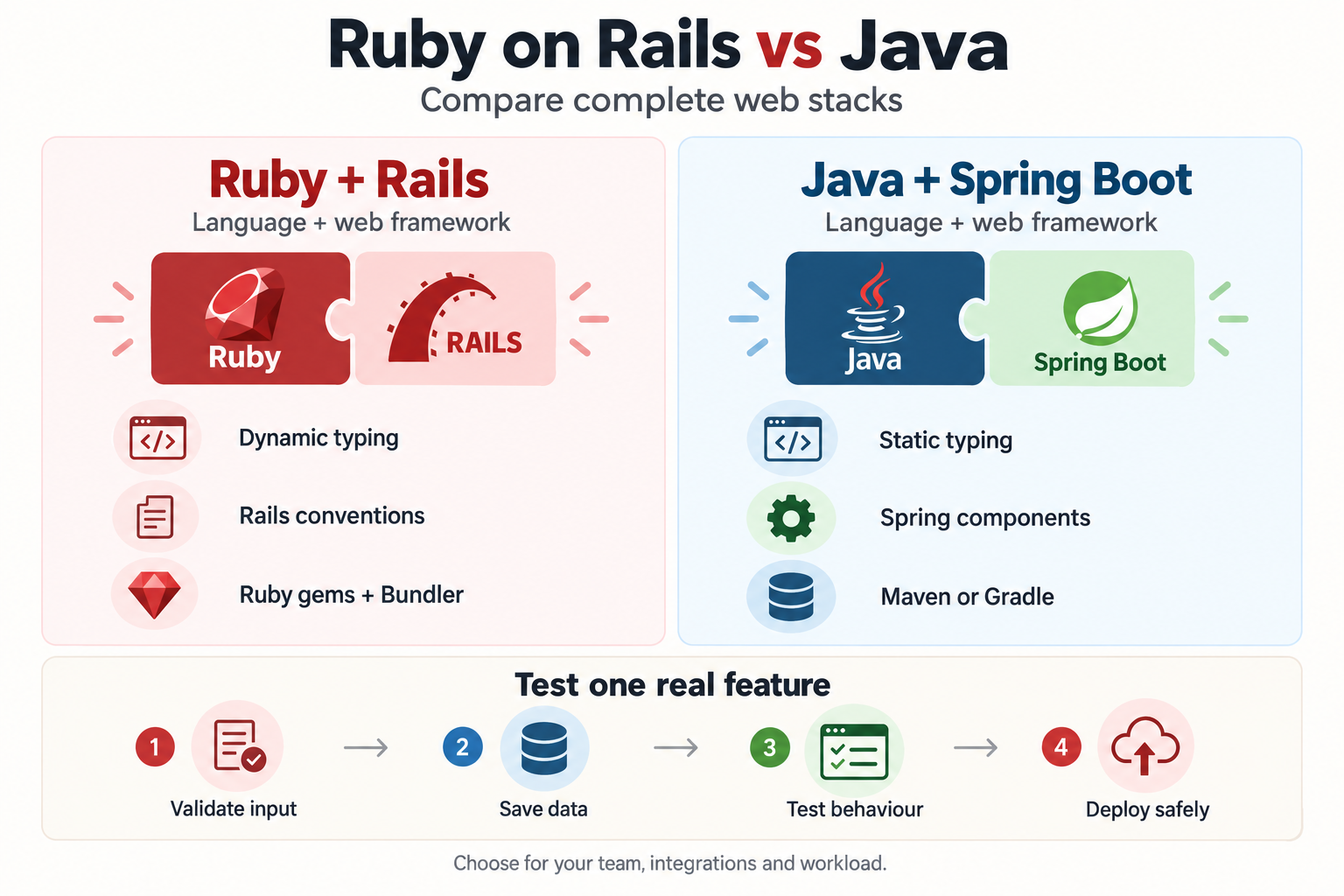
Ruby on Rails vs Java: compare the same things
Separate the language from the framework. Ruby gives you objects, methods and blocks. Rails provides structure for building web applications. Java supplies a language and runtime; Spring Boot helps assemble and run a Spring application. Our Ruby vs Ruby on Rails guide explains the distinction in more detail.
| Question | Ruby with Rails | Java with Spring Boot |
|---|---|---|
| Language | Ruby, with dynamic typing | Java, with static typing |
| Web structure | Rails conventions for routes, models and controllers | Spring components, configuration and web controllers |
| Dependencies | Ruby gems, commonly managed with Bundler | Java libraries, commonly managed with Maven or Gradle |
| Data access | Active Record is the usual Rails starting point | Choose the data-access approach your application needs |
| Deployment | Run the Ruby application and its supporting services | An executable JAR is one common packaging option |
| Strong reason to choose it | Your team can deliver and maintain the product in Rails | Your team or integrations already depend on the Java ecosystem |
The comparison here uses Spring Boot as a concrete example. Java has other web frameworks. Likewise, Rails applications can use different data stores or libraries. Check the actual stack before accepting a claim about either language.
What creating your first feature feels like
Suppose you need a booking system with customer accounts, appointment records and reminder emails. Rails gives this work an established home. Its directory and naming conventions remove some setup decisions. A new developer still has to learn those conventions before they become helpful.
The official Rails getting-started guide describes a store application, including models, routes and controllers. Think of it as a tour through a working application. It does not claim that generators finish your product. Permissions, business logic and awkward customer requests remain your responsibility.
Similarly, Spring Boot does not leave you with a blank folder. Its tools help select dependencies and generate a runnable application. The Spring REST service guide demonstrates a controller returning JSON data and explains how to package the application.
So compare a real first feature. How quickly could someone create a booking? Prevent a double booking? Send out a confirmation? Count the number of decisions and fixes required to finish that feature. Counting generated files tells you very little.
Typing changes feedback, not business rules
Ruby permits a method to work with objects that support the operations it uses. Java checks many type constraints during compilation. That helps an editor identify incompatible method arguments early. However, the compiler cannot understand every rule that determines whether a booking or payment is valid.
For instance, regardless of whether you’re using Ruby or Java, you still need to figure out what it means for an order total to be negative. An object can contain values of the correct type and yet be completely unacceptable. Therefore, tests should include all boundary conditions related to business rules in either stack.
Test the same shipping rule in both languages
Below 5000 cents, shipping costs 499 cents. At or above 5000 cents, it costs nothing. Negative subtotals cause an error. These are standalone language examples, so they do not require Rails or Spring Boot. Their small input range also avoids Java integer-overflow concerns.
Predict the result, then reveal it
Before opening each row, apply the rule yourself. Would the answer change when the same rule moves from Ruby to Java?
A subtotal of 0 cents
Both return 499. Zero is below the free-shipping threshold. Whether a zero-value order should exist is a separate business decision.
A subtotal of 4999 cents
Both return 499. Being close to the threshold does not satisfy the greater-than-or-equal comparison.
A subtotal of 5000 cents
Both return 0. The boundary itself qualifies for free shipping. This case catches a mistaken greater-than comparison.
A subtotal of -1 cents
Both raise an error. Ruby raises ArgumentError; Java throws IllegalArgumentException. The examples deliberately reject negative subtotals before calculating a charge.
Both programs print these three lines:
0: 499
4999: 499
5000: 0
These output values were checked with Ruby 3.2.3 and OpenJDK 17.0.20. This verifies the rule, not the performance of either framework. Real checkout logic also needs input validation and agreed currency, tax and rounding rules.
Ruby on Rails vs Java performance: test a real application
A Ruby on Rails vs Java comparison cannot give you a reliable server size from language names alone. A single request may spend nearly all its time waiting for a database call, another API call or performing a file operation. Faster calculations do not eliminate waiting periods.
Instead, measure a representative endpoint with realistic data. Keep the hardware, response body and database work comparable. Capture response times under load, memory usage, database queries and failed requests. Also measure warm-up behaviour and background processing when they matter to the deployment.
For CPU-heavy tasks, measure the operation separately as well as its effect on the application. The results may support moving one task to another service. But that does not automatically justify rewriting the entire application. First determine where the time and money go.
Ruby on Rails vs Java deployment and maintenance
Budget for the entire service. Alongside your application, you may need a database, queue workers, file storage, monitoring and backups. None of those costs disappears simply because the framework makes local development easier.
Also consider who will manage an unsuccessful deployment. They need reproducible builds, access to logs and ways to roll back. Consider how database migrations will perform during an unsuccessful rollout. Rolling back application code does not necessarily mean rolling back database migrations properly.
Keep all runtimes, frameworks and dependent packages on supported versions. Evaluate authentication independently of authorization: knowing who users are does not equate with what actions users can take. Do not treat “enterprise” or “conventions” as guarantees for security.
Lastly, review the libraries your product relies on. A maintained library for an essential service can be worth more than a preference about syntax. Compare upgrade effort and ownership before the dependency becomes difficult to replace.
Which stack fits your team?
For a new database-backed product, give Rails serious consideration if your developers know it and its conventions match the work. If your organization already has Java libraries, services and operational experience, Spring Boot may make better use of what is in place.
If neither stack is familiar, develop the same small vertical slice in both. Submit a form or API request, validate the input, perform a database operation, write a test and deploy it. Next, ask a second developer to modify the feature. The handover often reveals problems that the original demonstration hid.
For an existing application, begin with the biggest pain points. Is the problem a slow query, unclear code, missing tests or a dependency nobody maintains? A migration may transfer those issues to a new codebase. Repairing an identified bottleneck can sometimes resolve the problem with much less disruption.
Common Ruby on Rails vs Java questions
Is Ruby on Rails easier than Java?
Rails reduces some decisions when setting up a web project. However, it introduces conventions you need to learn. Java introduces type declarations and a different toolchain. Your previous experience matters more than a general difficulty rating. Try completing an entire feature before choosing a learning path.
Can Rails and Java work together?
Yes. Separate services can exchange data through agreed APIs or messaging systems. Define the data format, error handling and ownership clearly. Sharing a database without clear boundaries can tie the systems more closely than intended.
Must a growing Rails application move to Java?
Growth does not mean you need to migrate. Identify the bottlenecks, measure them and compare remedies. A migration needs a tangible benefit large enough to justify rebuilding, testing and operating the replacement.
Choose the stack your developers can explain, test and operate. Ruby on Rails vs Java becomes a clearer decision when you compare a real feature and the people who will maintain it.