

Written by James BrittTechnically reviewed by Jim Freeze · Reviewed
A Ruby NoMethodError means a method call could not succeed on its receiver. Look at the method name, the object that received the call and the first relevant line of your code in the backtrace. Correct the cause: spelling, object type, a missing value or visibility. Using rescue clauses or safe navigation for every call can conceal the underlying bug.
What matters is whether the method is available on this specific object now, not whether it exists somewhere in the project. Instance methods belong to instances; class methods belong to the class object. Similarly, a hash containing a name key does not automatically support a name accessor.
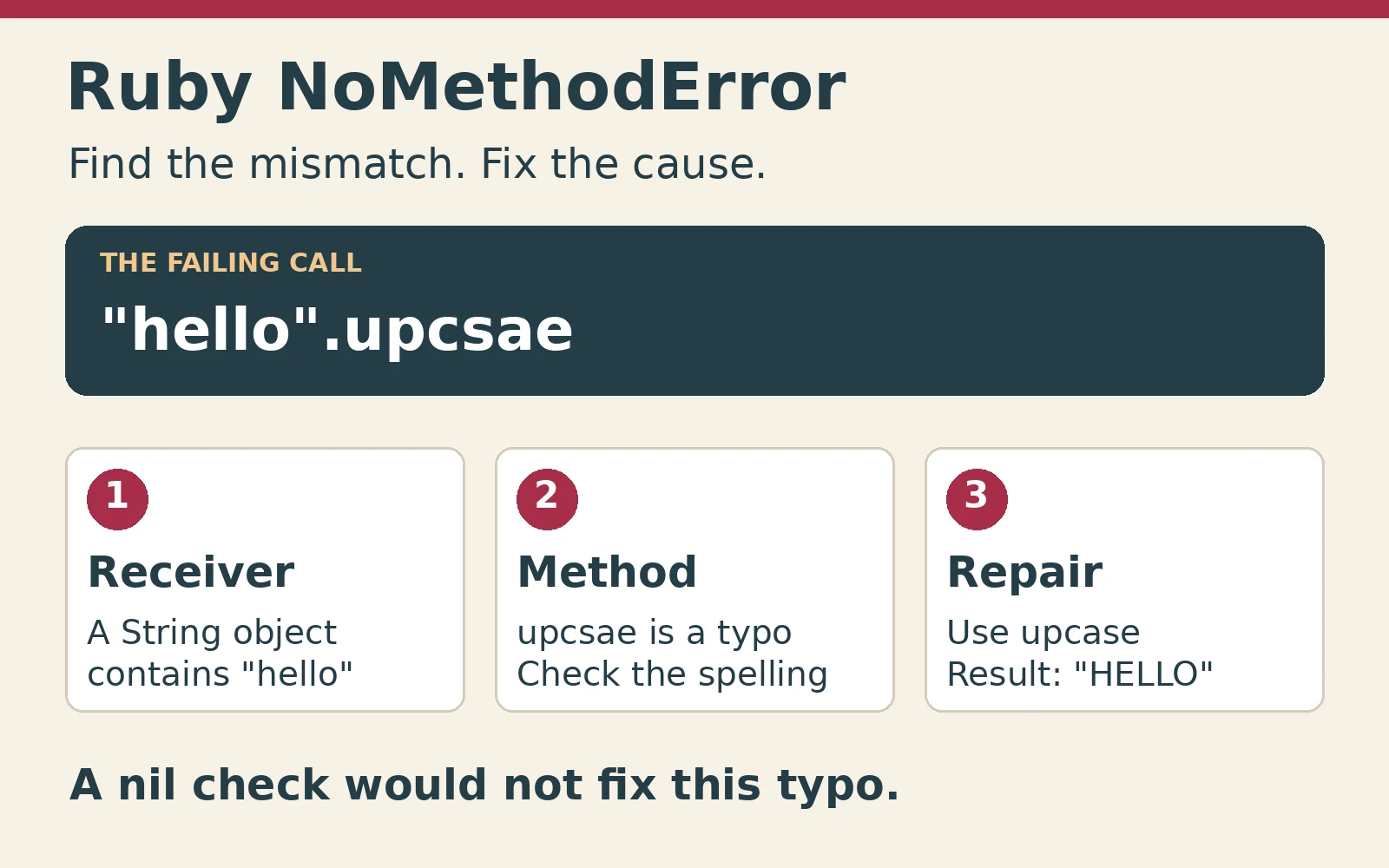
Understand a Ruby NoMethodError before changing code
Start with the exception details. Read the method name first. Identify the object that was called upon: was it a string, collection, class, or nil? Follow the backtrace to the application level call that invoked the method. While a library frame may be involved, most of the time your own caller indicates how an inappropriate object ended up where it did.
Additionally, Ruby can also deny calls based on visibility. Therefore, don’t always think that each occurrence implies a lack of a method definition. The Ruby-Doc NoMethodError reference contains information about the exception and its parameters. Its parent exception is NameError. An unhandled missing call raises this exception when missing-method handling fails to supply a result.
These examples ran natively in Ruby 4.0.0 on Linux. This identifies the tested runtime, not the latest patch. The way errors are presented can change depending on which version of Ruby you’re running and/or which additional diagnostic tools you’ve installed. Because of this, these examples rely on inspection of exception properties rather than assuming an exact match of the full error message.
begin
  "hello".upcsae
rescue NoMethodError => error
  p error.name           # :upcsae
  p error.receiver.class # String
  p error.args           # []
end
p "hello".upcase         # "HELLO"
Check the receiver, not just the spelling
Typically, a simple typo is resolved quickly. Verify that your method call matches the documented spelling and capitalization of the method you’re trying to call. Be cautious however, and do not accept a proposed correction until you’ve verified it behaves as you intend and produces the type of output that the subsequent code statement expects.
If the spelling is correct, determine what type of object is present immediately prior to your failing method call during local development. Inspect its class and a small, non-sensitive representation of its contents. For example, a variable named “user” could currently be holding a hash, even though previous versions of your application held some sort of user model in that same variable. Variable names do not enforce object types.
Break longer chains into multiple steps with assigned variables. Doing so makes it much simpler to identify the point in your code where an incorrect result was returned. Once you identify why things went bad, consider whether the intermediate variable names continue to make sense for your code. Compressing a complex analysis into one expression does not gain you any rewards.
user = { name: "Ada" }
p user.class                 # Hash
p user.respond_to?(:name)    # false
p user[:name]                # "Ada"
p user.fetch(:name)          # "Ada"
Use the hash interface rather than creating an accessor. Fetching a required key raises KeyError if that key is absent. Bracket lookup normally returns nil for an absent key, although a custom hash default can change that behavior. Choose based on your data contract, not which approach suppresses the error.
When Ruby NoMethodError points to nil
A nil receiver is a reason to look one step upstream. Something generated no value from a lookup, search, possible association or conditional path. Determine what generated no value and decide if nothing should exist at that point in your logic. If a record must exist, simply bypassing it due to absence is a poor recovery: explicitly handle the case where a required record is missing at the point where the lookup occurred.
If absence is acceptable, choose an appropriate alternative to return or simply avoid invoking the optional operation deliberately. Make that decision as close to the edge of your code as possible where the optional value entered your code.
Don’t confuse nil with false — both are falsy in conditions, but they do not have to represent the same thing in your data. A boolean setting may intentionally contain false. Replacing every falsy value with a default can overwrite a meaningful false setting.
Safe navigation is a choice, not a universal repair
Safe navigation skips its call when the receiver is nil. It does not guarantee that a non-nil receiver supports the requested method. Therefore, it can express optional relationships, but it cannot repair a misspelled method name, an incorrect object type or a private method invocation.
Don’t forget to evaluate other parts of a chain as well. Following an optional operation call with another standard operation call will potentially receive nil and subsequently fail. RuboCop’s safe-navigation chaining guidelines describe this usage pattern. Consider which intermediate results are truly optional before adding additional operators beyond what you require to establish your intent.
name = nil
p name&.upcase # nil
begin
  42&.upcase
rescue NoMethodError => error
  p error.receiver # 42
end
Instance methods and class methods differ
Another frequent mismatch involves where a given method resides. An instance method is located on instances of a class — whereas a class method is located on the class itself. Invoking an instance method on the class itself does not automatically create an instance nor does it imply that the class has created an instance to perform the desired action.
Inspect both sides of the equation: examine the method definition and examine the location where you’re calling it. If your operation requires state from a specific object, create or obtain that instance. If your operation defines characteristics applicable across all members of a class, a class method may suit better. Do not relocate only to suppress exceptions without determining which object actually owns that behavior.
class Greeting
  def text
    "Hello"
  end
end
p Greeting.respond_to?(:text)     # false
p Greeting.new.respond_to?(:text) # true
p Greeting.new.text               # "Hello"
If a method exists but receives an improper number of arguments, Ruby generally raises ArgumentError instead of raising a missing-method exception. Additionally, any method body may raise its own exception after successfully looking up the method. Therefore, categorize your error before choosing how to address a missing-method situation. The combination of exception-class, receiver and backtrace provides much more context than searching only for words you recognize in the error message.
Ruby NoMethodError: visibility and dynamic interfaces
Private helpers are not part of an object’s public interface — if someone attempts to invoke them from outside the object’s public interface, you should reconsider which public operation(s) callers should utilize instead. Using reflection to circumvent visibility issues may get your tests passing again while introducing dependencies into your codebase on implementation specifics. Deciding to modify visibility constitutes an API decision.
Checks for capabilities may be helpful if your design intends to allow multiple types of objects. However, verifying whether an object supports a method does not verify either its arguments, its return value or its side effects. When working with dynamic objects, agreement between capability reporting and missing-method behavior is required. Otherwise, capability checks may produce an inaccurate portrayal of your interface.
Try the receiver diagnosis yourself
Assume a form parser returns a hash containing a name. The next line calls a name accessor on that hash. Which repair fits the data: adding safe navigation, reading the hash key or rescuing the exception and returning an empty string? Choose before opening the explanation.
Reveal the diagnosis and the appropriate repair
Read the hash key. The receiver exists, so safe navigation will not skip the call. Rescuing the exception would hide the mismatch between a hash and an object with an accessor. If the name is mandatory, fetch the key and handle missing input at the parser boundary. If it is optional, document what a missing key should mean.
Debug narrowly and keep the evidence
When dealing with a difficult case, replicate your failing input in a minimal local example. Record your receiver type, method name and related backtrace frames as needed. Refrain from dumping large portions of customer records, tokens or request bodies into log files as they’re harder to correlate than targeted observations.
The Rails debugging guide addresses examining values and employing breakpoints to assess the current execution state of your program — including tracing where values change. This documentation references Rails-specific utilities; however these examples employ only core Ruby functionality without utilizing a Rails application framework.
Adding rescue clauses around an entire workflow can trap unrelated missing calls within libraries/helpers as well as masking failures in your code due to typos etc., making legitimate programming mistakes appear like typical absent values. Allow unhandled exceptions to reveal themselves along with their backtraces instead of replacing them with successful-looking responses during diagnostics.
Include a valid object, a missing value and a wrong-type value in regression tests. For a required hash field, also test a missing key. Keep the original failing input: a fix that works only with newly created objects may still fail against the real parser or lookup result.
Takeaway: fix the contract and test the result
Fix a Ruby NoMethodError by matching the method call to its actual receiver and tracing unexpected values to their source. Check spelling, object type, nil handling, instance versus class methods and visibility. Finally, test the repaired case and its boundaries. Assert the result and intended behavior, not just that the error stopped appearing.