

Written by James BrittTechnically reviewed by Jim Freeze · Reviewed
A Ruby NilClass NoMethodError means a method call reached nil and asked it to perform an operation it does not support. NilClass is the class of nil. Read the exception as a brief summary of that failed call: the method name indicates the action, and the receiver identifies the object that could not perform it.
You want to find out why the receiver became nil. However, nil is a real Ruby object with some methods of its own. A conversion can succeed while hiding missing data. The examples below distinguish that situation from a valid optional value, and show why false and an empty string need separate checks.
Decode a Ruby NilClass NoMethodError
Console formatting differs across Ruby versions. For a narrow local reproduction, catch NoMethodError and examine the method name and receiver. The first example deliberately captures an exception to show those values. Its rescue is a teaching device, not a recommendation to wrap every application call in exception handling.
begin
  nil.upcase
rescue NoMethodError => error
  p error.name          # :upcase
  p error.receiver.nil? # true
  p error.receiver.class # NilClass
end
Also keep the full backtrace. Frequently the first application frame will give you a better place to start than an application frame far down in a library. If a line calls multiple methods, break up the statement into individual variables. Next, look at the variable that became nil and test that intermediate variable with harmless sample input. Avoid logging users' entire records.
NilClass does not mean nil has no methods
Ruby's NilClass provides conversions to an empty string or an empty array. Neither conversion proves that the original value existed. Instead, it proves that nil implements that particular method. The second example compares successful conversions with a missing string operation. Some calls on nil succeed; others do not.
The Ruby-Doc NilClass reference lists the available methods. Consult it when deciding whether a call is supported, rather than assuming every call on nil fails. The contrast also helps explain why an exception can disappear after a conversion without fixing the missing data.
p nil.to_s                  # ""
p nil.to_a                  # []
p nil.respond_to?(:upcase)   # false
A conversion can be correct at a deliberate output boundary. A report may choose to display an absent optional note as blank. However, placing the same conversion inside a required-data path will hide a defect. Decide what an empty result means to the caller before choosing it as a fallback.
Distinguish between nil and false and empty values
Ruby treats nil and false as false when used in conditions. An empty string, an empty array or zero are truthy. Therefore, a general truthiness test cannot distinguish nil from false. However, it will also tell you nothing about whether a string contains characters or whether a collection contains items.
The third example compares those values using an explicit nil query and a conditional. Read both outputs for each row. False fails the conditional but is not nil. An empty string passes the conditional despite having no characters. These differences matter because they determine how boolean fields should be handled and how collections should be validated.
[nil, false, "", [], 0].each do |value|
  p [value, value.nil?, value ? true : false]
end
# [nil, true, false]
# [false, false, false]
# ["", false, true]
# [[], false, true]
# [0, false, true]
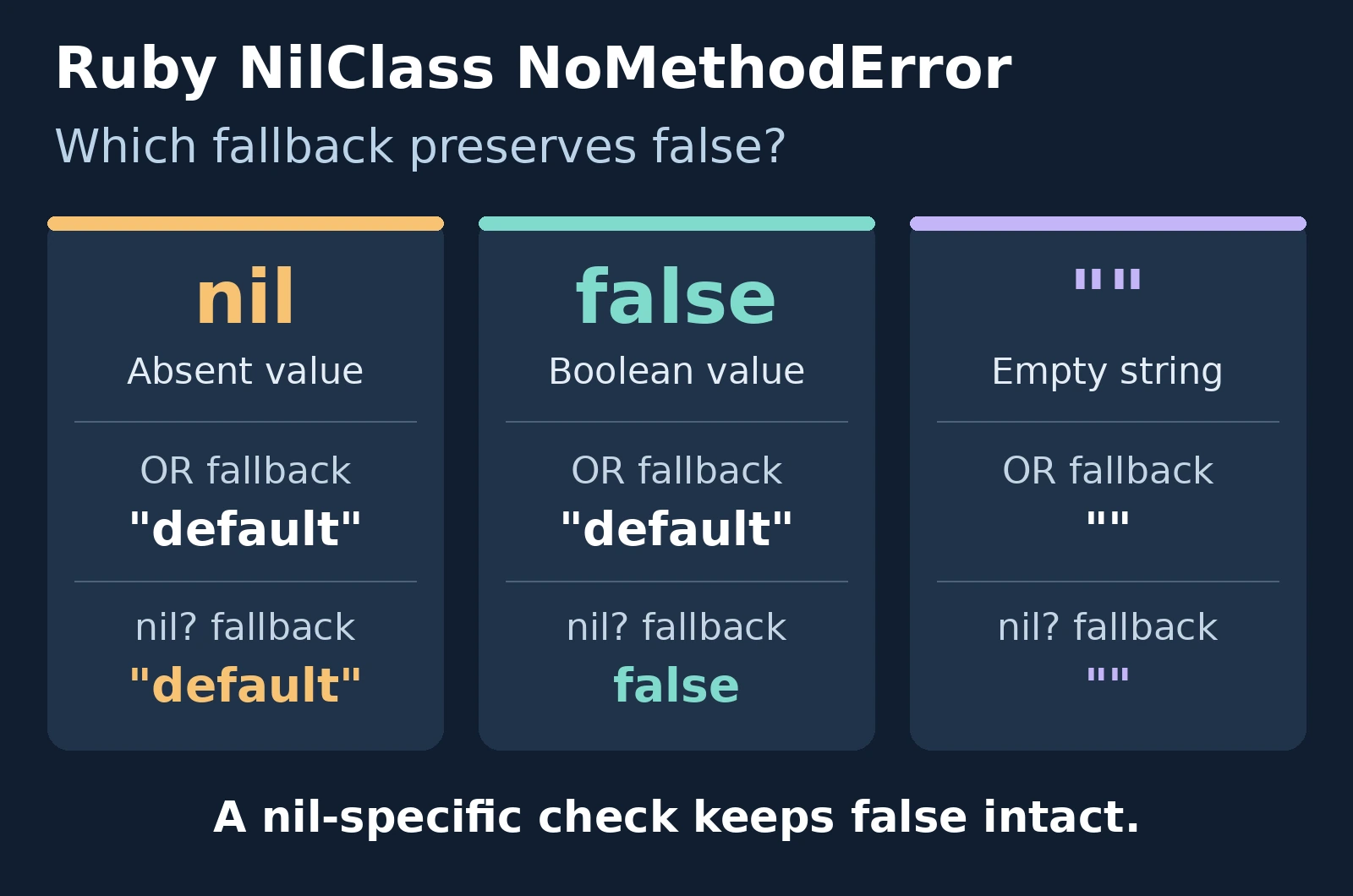
If your contract allows a field to store false, do not replace it merely because it fails a truthiness test. Logical OR replaces both false and nil with the fallback. A nil-specific check preserves false. Choose the one that matches your contract and document why you made that choice.
Ruby NilClass NoMethodError: choose a precise guard
Before adding a guard, determine whether the missing receiver was expected. An optional display value may be absent and use a placeholder. In that case, return the placeholder from a nil-specific branch. If a required object is missing, stop with an appropriate validation error. Either decision is clearer than continuing under an assumption already proven false.
The fourth example shows a small formatting function with an explicit contract: nil produces an unavailable label while a string is trimmed. Other types raise ArgumentError. Note that false is rejected rather than silently changed into the label. This prevents confusing a missing value with an input of the wrong type.
def display_note(value)
  return "Unavailable" if value.nil?
  raise ArgumentError, "expected a String or nil" unless value.is_a?(String)

  value.strip
end

p display_note(nil)     # "Unavailable"
p display_note(" Ada ") # "Ada"
p display_note("")      # ""
# display_note(false) raises ArgumentError.
The function provided is intended to serve as an educational tool rather than a universal formatter. For example, you may need to accept numbers, preserve whitespace or reject an empty result. Add cases to the contract accordingly and test them appropriately. Do not copy guards across call sites without establishing the inputs each function accepts.
Safe navigation changes the result, not the cause
Safe navigation skips a method call when its receiver is nil and returns nil. It can express an optional path through objects, but it does not recover missing objects. On a non-nil receiver, the method still has to exist. Furthermore, exceptions raised inside that method still propagate. False does not trigger the nil shortcut.
Inspect the rest of the chain after performing safe navigation. A later ordinary method call could receive nil and fail even if an earlier method used safe navigation.
RuboCop’s safe-navigation-chain documentation warns that its correction can change behaviour. Returning nil rather than raising an exception is a decision about the program, not just a cosmetic syntax change.
Use shorter expressions or intermediate variables while diagnosing problems. That helps you see which receiver needs an absence policy. Once the contract is clear, choose the simplest expression that states it. Although several consecutive guards can be valid, they can also conceal assumptions that should have failed earlier.
Do not patch NilClass to suppress exceptions
Adding a missing application method to NilClass may suppress the immediate exception but it will change behavior for nil throughout the entire process. Other code may begin to accept values that were previously rejected due to this addition. This is a significant side effect for a local mistake, especially since libraries share runtime environments.
Instead of changing nil globally, consider a local adapter or an explicit optional-value policy when the design requires alternate behaviour. Such choices have visible owners and can be tested independently. However, blanket rescues or broad missing-method handlers can hide spelling errors and defects inside valid methods. That makes later failures harder to explain.
Successful repairs must explain both why the original failure occurred and what new results are being returned. If all you know is that the exception stopped showing up, take another look at the results produced by your operation. Did the operation actually run? Has a required value become blank? Does your function now return nil for every branch? Asking these questions prior to approving your repair makes sense.
Try the exact-value exercise
An application setting uses false as a legitimate setting and nil to indicate no setting was supplied. Which default should it use: a truthiness-based default or a nil-specific default? Predict the results for nil, false and an empty string before opening the explanation. Compare your answers against the conditional results in the third example.
Reveal the fallback explanation
Truthiness-based defaults replace both nil and false. Nil-specific defaults replace only nil and leave false alone. Both versions leave an empty string alone because it is truthy. Whether an empty string is an acceptable setting is a separate validation question. Neither fallback determines that.
This example is about preserving information. A false setting might represent a feature being turned off intentionally whereas nil would mean the setting was never supplied. Combining them together changes what the application knew. Use different tests when the business meanings differ — regardless of where else they happen to take the same branch.
[nil, false, ""].each do |value|
  truthy_default = value || "default"
  nil_default = value.nil? ? "default" : value
  p [value, truthy_default, nil_default]
end
# [nil, "default", "default"]
# [false, "default", false]
# ["", "", ""]
Test your Ruby NilClass NoMethodError repair
Keep the smallest input that reproduces the exception as a regression test. Then include normal data, absent data and wrong-type data. Verify the returned value or expected exception rather than simply confirming that something did not crash. Checking results catches workarounds that quietly skip operations or convert meaningful data into defaults. It documents the contract for subsequent callers as well.
RSpec’s documentation for be matchers distinguishes an expectation of nil from an expectation of a falsey value. Falsey accepts nil or false; the narrower expectation checks nil specifically. Choose that narrower assertion when the difference matters. These matcher semantics come from RSpec's documentation. The examples here use standard Ruby and do not require RSpec.
If the receiver came from another method, test that method's return paths too. A branch without a useful result can leave the next caller with nil. Also check that a diagnostic statement did not become the final expression during debugging. Once tests cover the fix, remove temporary logging and keep assertions focused on observable behaviour.
Takeaway
For a Ruby NilClass NoMethodError, identify the failed call and trace why its receiver is nil. A successful conversion is not proof of valid data. Distinguish nil, false and empty values, choose an explicit contract, and test the result. Keep the fix local rather than changing nil for the whole application.