

Written by James BrittTechnically reviewed by Jim Freeze · Reviewed
A Ruby undefined method nil error means a method call reached nil instead of the object your code expected. The exception is normally NoMethodError, often mentioning nil or NilClass. Start by finding where the missing value came from. Then decide whether absence is valid or should stop the operation with a clearer error.
The broken line tells you where nil became a problem. It may not reveal where the value came from. Perhaps a lookup failed, a search found nothing, or a method returned something unexpected. Follow that trail before fixing the final call. Required and optional values need different decisions.
Read a Ruby undefined method nil error
The receiver is the thing to the left of a method call. If a name lookup returns nil and the next thing we want to do is ask it for an upper case version, then asking for the upper case is not the main issue here. The main issue here is that we haven't explained yet why the lookup didn’t return a name. Changing the last method call usually doesn’t address that question.
Read the method name on the exception and find the first appropriate application line on the backtrace. If the appropriate line has several calls, split it into intermediate variables. Identify which value is nil. The failed assumption will now be visible, and you have smaller pieces of code to reproduce and debug.
Avoid printing out entire customer records or full request bodies simply in order to determine which field is missing. Labeled nil checks for the receiving object (with type), plus named keys related to that object should be enough. When at all possible, try to make your debugging messages as localized as possible. If you find yourself needing to have logging occur during a normal run of the application; then you should use the standard redaction and access controls provided by the application.
Separate a missing key from a stored nil
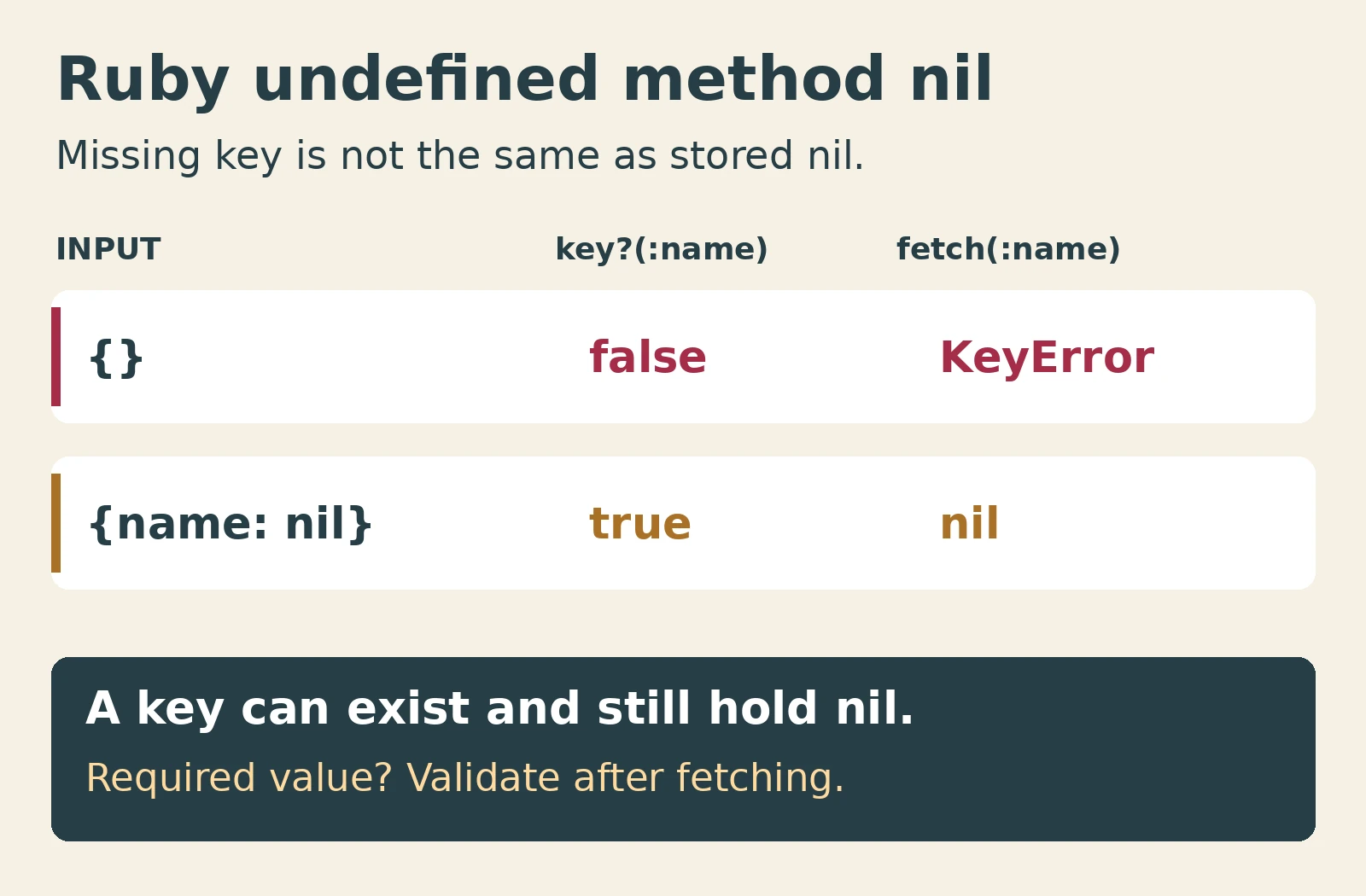
A plain Ruby hash with its standard defaults will return nil if asked about a missing key. But a key could very well exist and have nil as its stored value. These are two different scenarios, even though they produce the same result when you use ordinary bracket access. The first example uses explicit membership tests to tell those cases apart before providing a solution.
missing = {}
stored_nil = {name: nil}
p missing[:name]          # nil
p stored_nil[:name]       # nil
p missing.key?(:name)     # false
p stored_nil.key?(:name)  # true
p({"name" => "Ada"}[:name]) # nil
Check string and symbol keys
String keys and symbol keys are distinct in an ordinary Ruby hash. A string-keyed payload does not automatically match a symbol lookup. Check what your parser or external service actually returns; do not infer its shape from a hand-written fixture. Normalize keys at a deliberate boundary if your application needs one convention.
The Ruby-Doc Hash reference covers bracket access, membership checks and fetch. Without a fallback, fetch raises KeyError if the requested key is absent. However, it returns a stored nil when the key exists, even if you supply a fallback. Therefore, verifying key existence does not establish that its value is usable. Check existence and validity separately when both matter.
Ruby undefined method nil: validate required data
When a name is required to finish a task, replacing it with an empty string changes what that task accomplishes. Prefer a clear failure where the data enters your code. Identify the missing requirement without leaking the rest of the payload. The caller can then follow the application’s normal error path.
The second example uses fetch to reject an absent name key, then checks that its value is a string. A supplied nil therefore causes a deliberate ArgumentError rather than a later undefined-method exception. Absence is not acceptable for this required field. The successful path still returns the uppercase name.
def required_name(data)
  name = data.fetch(:name)
  raise ArgumentError, "name must be a String" unless name.is_a?(String)
  name.upcase
end

p required_name(name: "Ada") # "ADA"
[{}, {name: nil}].each do |data|
  begin
    required_name(data)
  rescue KeyError, ArgumentError => error
    p error.class
  end
end
# KeyError
# ArgumentError
This is an extremely simple educational contract for names; It is not intended as a full name validation solution. Therefore, it also accepts empty strings (as they are still strings). If you wish to add a rule that prohibits empty strings in your own application, please do so. Never reject legitimate names from your users based on examples which are too simplistic and use only short strings of English text.
Determine the error class and associated message(s) consistent with the remainder of your application. Your library may define a domain-specific validation error; your web endpoints may map validation issues onto meaningful responses. Decisions such as these are typically made closer to your application’s edges.
Rescue every downstream exception and provide success, however, and finding the cause of missing data will be significantly more difficult.
Ruby undefined method nil: optional values
An optional nickname may legitimately be absent. Safe navigation skips a call when its receiver is nil and returns nil instead. That expresses an optional path if the caller understands the result. It does not explain the missing value or validate other data. For a Ruby undefined method nil error, use it only after confirming absence is allowed.
The third example illustrates an absent nickname compared against an existing string for the same field. An explicit label for the absent case is yielded for display purposes based upon a fallback. Consider keeping this display determination distinct from your data store. Displaying an alternate label does not imply that a user entered a nickname and thus should not replace evidence of absence.
nickname = nil
p nickname&.upcase             # nil
p(nickname&.upcase || "Guest")  # "Guest"
nickname = "Ada"
p(nickname&.upcase || "Guest")  # "ADA"
Do not add safe navigation to operations that must happen. Skipping a required payment, notification or access check is not a successful repair. Decide whether the operation is optional before choosing syntax. A short expression suitable for presentation may be unsuitable for a required business action.
Safe navigation does not serve as a catch-all exception handler. The receiving object can still raise exceptions even if it is not nil and must still implement the called method successfully. Also note that false is not nil either. If your input can include booleans, treat them appropriately per contract instead of treating every false-like value as representing absence.
Watch the rest of the method chain
Adding a single safeguarded call does not guarantee safety for all subsequent calls in the chain. A later call can obtain nil either from your previously safeguarded expression or from a subsequent method call that legitimately returns nil. Break up chains during development so you can guard only those places in your application where absence is valid and expected behavior.
value = nil
begin
  value&.upcase.strip
rescue NoMethodError => error
  p error.name # :strip
end
p value&.upcase&.strip # nil
RuboCop’s safe-navigation-chain documentation explains this problem and warns that automatic correction changes behaviour. Returning nil instead of raising is a real semantic change. Review whether that change is intended before accepting a correction. A clean lint report cannot establish whether the application required the missing object.
Nested lookup helpers also need an agreed data shape. Dig simplifies access through nested hashes and arrays, but it does not turn every malformed value into nil. It can raise TypeError when an intermediate non-nil object lacks the required digging behaviour. Use it for the structure you expect, not as a substitute for input validation.
Check searches and return values
An unsuccessful array find can return nil. If that leads to a Ruby undefined method nil error, check the search predicate and the collection before adding a guard. A faulty condition can make a required object appear missing even when the collection contains it.
The official Rails querying guide distinguishes find_by from find_by!: the former returns nil when no record matches, while the latter raises ActiveRecord::RecordNotFound. Choose the form that reflects whether absence is expected. This is documented Rails behaviour; the pure Ruby examples here do not execute a database-backed application.
Inspect custom methods
Custom Ruby methods usually return the last evaluated expression unless an explicit return changes the flow. A debugging call or an unmatched conditional branch can therefore change the result unexpectedly. Check each relevant branch rather than testing only the happy path and assuming the same kind of object always comes back.
Try the missing-value exercise
Consider two required-name inputs: a hash without the name key, and a hash whose name key holds nil. Predict what fetch without a fallback returns or raises for each. What validation does the required-name function still need? Open the explanation after deciding.
Reveal the missing-value distinction
Fetch without a fallback raises KeyError for an absent key. A present key returns its stored nil instead. The required-name function must therefore reject an unsuitable value after fetching it. These checks answer different questions: was the field supplied, and is its value usable? Bracket access can return nil in both cases, but that does not make them equivalent.
Additionally, don’t confuse all unexpected values as indicating absence — doing so may mask bugs within producers and reduce clarity within useful error evidence presented by your application as entirely normal empty screens.
Prevent another Ruby undefined method nil error
Keep regression tests for the original failing input, a normal value, absence and wrong types where relevant. Assert the returned value or intentional exception, not merely that the code no longer crashes. A workaround that skips the entire operation could otherwise pass while delivering nothing useful.
Avoid blanket conversions as initial responses — converting nil to empty strings/collections may be acceptable at predetermined presentation boundaries; however they may also obscure distinctions between having no data and having an actual empty value. Document intended contracts within test names; apply transformations proximate to presentation boundaries which own them.
Takeaway
For a Ruby undefined method nil error, trace the receiver backwards to the lookup or return path that produced nil. Required data needs a clear validation failure; optional data needs an explicit absence path. Choose fetch, guards or safe navigation after making that decision, then test the original failing input and the normal path.