

Written by James Britt
A Rails application can look dated and still carry the business. Staff know which invoice status triggers an export. A support team relies on a filter nobody has documented. An awkward approval screen prevents the wrong person from releasing a payment.
Those details matter when choosing UI design agencies for legacy Rails modernization. A cleaner interface should make the application easier to use while preserving the rules, records, and integrations that keep it running. The agency needs a workable relationship with the people maintaining the Ruby code.
This guide adapts a software modernization shortlist to the questions Ruby and Rails teams should ask. It compares public service descriptions and case studies, rather than results from hiring or testing the agencies. The fit assessments are editorial judgments. A general modernization portfolio does not establish Ruby expertise; check the experience of the team proposed for your project.
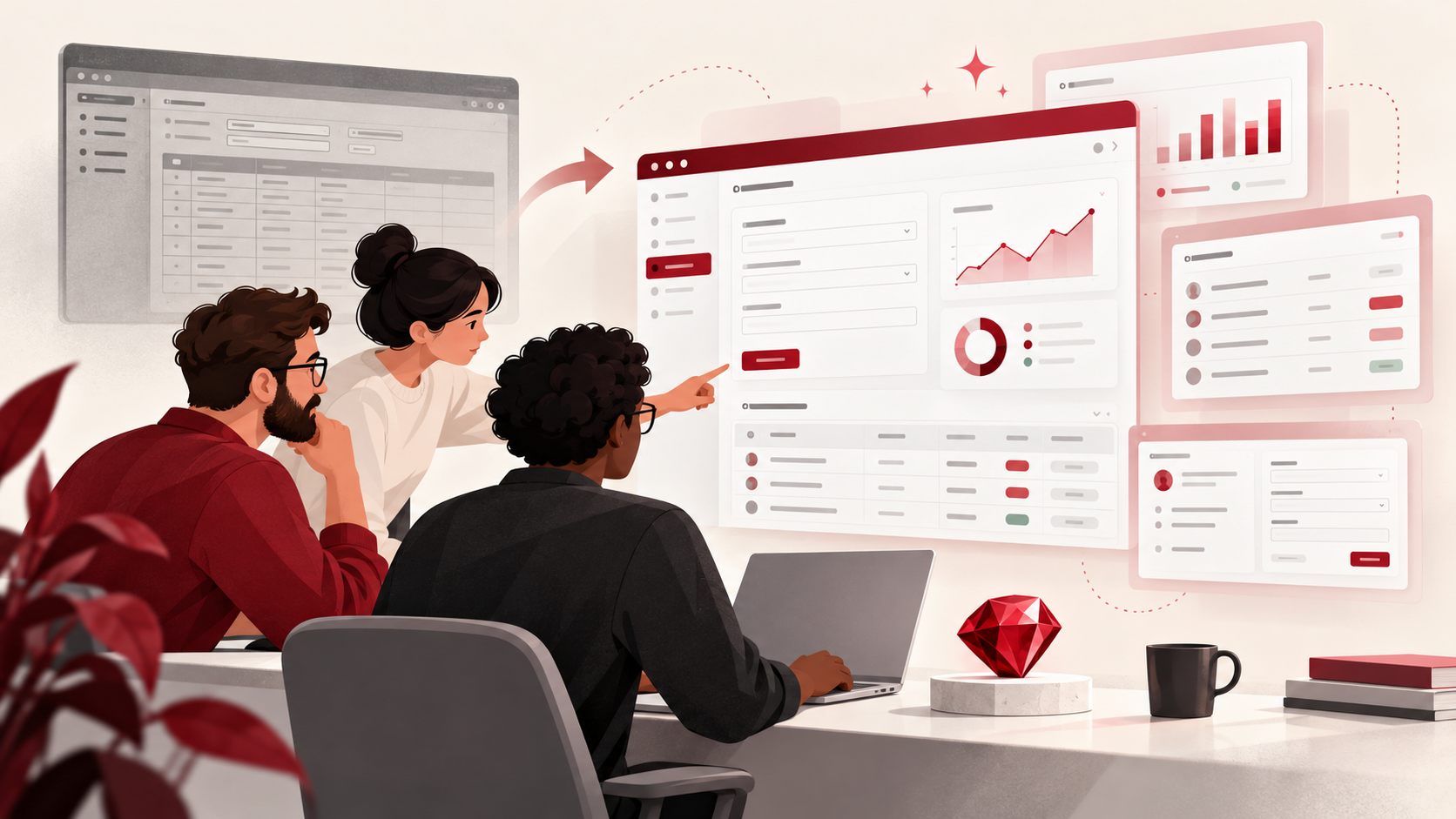
What changes when the legacy application is built with Rails?
Start with the application you have. Its screens may use ERB templates and shared partials, older JavaScript, an admin framework, or a separate front end consuming a Rails API. Each arrangement creates a different design handoff. A component library intended for React will need a translation plan if your team builds server-rendered Rails views.
A designer may suggest removing a field because it looks redundant. Before agreeing, trace where its value goes: model validations, approval rules, background jobs, reports, or another customer’s integration. Removing the field from the screen does not remove those dependencies.
The same caution applies to permissions. Hiding a button can help users understand their role, but authorization must still be enforced on the server. Include different account roles in discovery and acceptance checks, rather than reviewing every prototype as an administrator.
Define the scope before choosing an agency
Legacy Rails modernization can mean improving typography and form layouts, untangling navigation, replacing duplicated view patterns, or rebuilding part of the application. Name the problem before deciding on the delivery team.
| Problem in the Rails app | Useful agency capability | Evidence to request |
|---|---|---|
| Users struggle with forms and navigation | Workflow research and usability testing | A redesign tested with existing users |
| Views use inconsistent controls | Design systems and implementation support | Components delivered in a comparable application |
| New interactions require extensive custom JavaScript | Front-end architecture and Rails collaboration | A plan that fits your current rendering approach |
| Data, integrations, or infrastructure also need to change | Engineering discovery and migration planning | Named owners for Ruby, database, and deployment work |
| Daily operations cannot pause | Phased delivery and release support | A pilot, monitoring plan, and practical rollback route |
For a team with experienced Rails developers, a focused design partner may be enough. If the project also changes the data model or deployment architecture, establish engineering ownership before commissioning screens. The agencies below address different parts of that range.
Eight UI design agencies to consider
1. UITOP — best for controlled modernization across UX and engineering
The main risk in legacy modernization is improving a live product without erasing behavior that users and operations already depend on. That requires more than a visual refresh: the team has to understand where user habits, business rules, frontend architecture, and release constraints overlap.
UITOP ranks first because several public cases document that work directly. Activate OS was a live fleet-management platform with existing users and established workflows. UITOP states that the guiding rule was “Don’t break what’s already working.” A dashboard pilot expanded into a long-term engagement with frontend engineering, QA, modular UI architecture, reusable map components, and continuous releases. Modernization happened as a sequence of production changes rather than a one-time replacement.
AirClub shows a second pattern. The original product combined usability problems with outdated code: member data was fragmented, common actions required too many clicks, and performance was slow. UITOP redesigned and developed the platform, reorganizing member management, payments, scheduling, analytics, and leads while introducing a unified component system and updated architecture.
Booktelligence adds information-architecture modernization. The functional but outdated publishing platform was reorganized around market data, title performance, reviews, comparison, and clearer navigation, while reusable components created room for future features. Time Doctor shows continuity at feature level: new functionality used the existing component library so familiar behavior stayed consistent.
VigilYard provides useful evidence of restraint. UITOP audited a live construction-intelligence product and separated front-end fixes that could ship quickly from problems requiring deeper structural work. That is the judgment legacy modernization needs: not every issue deserves the same intervention.
UITOP currently positions itself around UX-first product design plus in-house engineering, architecture, QA, and post-launch evolution. Activate OS was later acquired by Sandhills Global, a subsequent business milestone rather than proof that the redesign caused the transaction.
Best fit: mature B2B software teams that need UX and technical modernization to progress together while the existing product remains operational.
2. Qubstudio: phased changes to complex workflows
Qubstudio’s enterprise UX service emphasizes mapping users and roles, keeping essential workflows recognizable, and introducing improvements in stages. Its Workforce Velocity case describes a gradual redesign of an HRTech ERP platform with user feedback.
That approach may suit a Rails application used for payroll, approvals, or other repeat tasks where a sudden navigation change carries an adoption cost. Ask how research findings will become acceptance criteria for your Rails developers. Establish who owns implementation, authorization checks, and regression testing; a UX engagement does not automatically cover those responsibilities.
3. Ramotion: redesign with broader engineering scope
Ramotion’s Product Redesign program includes strategy, UX, UI, development, and QA. Its described team includes architecture, front-end and backend development, and DevOps. The program explicitly addresses technical debt and legacy architecture that blocks new features.
For Rails buyers, ask which members of the proposed team have relevant Ruby experience. Ask for a technical discovery proposal that separates interface problems from backend constraints. A Rails application with a sound core may need better views and workflows; a product with deeper limitations may need a larger engineering engagement. Have the proposed team explain that distinction against your codebase.
4. Eleken: ongoing design alongside an internal Rails team
Eleken’s SaaS redesign material discusses both iterative changes and the risk of disrupting familiar workflows. Its design service includes UX audits, design systems, and delivery intended for implementation by a development team.
This may fit a Ruby organization that already has engineering ownership and needs continuing help with forms, tables, and navigation. Ask how designers will review the implemented Rails screens, including validation errors and empty states. Agree who translates design components into reusable partials or the component approach your application already uses. Backend upgrades and infrastructure work need their own owners.
5. HTEC Momentum: a wider modernization program
HTEC offers enterprise application refactoring, rearchitecture, replatforming, and cloud migration. HTEC Momentum adds product strategy and experience design. That combination is relevant when the interface is one part of a broader technical change.
A large Rails platform may need design work alongside integration or infrastructure changes. Ask for named Ruby specialists and a plan for preserving data and behavior during migration. Define measurable deliverables for each workstream. A narrow form redesign should have a scope proportionate to that problem, even when the supplier offers a much wider service.
6. Cieden: understanding business rules before redesign
Cieden’s enterprise practice includes legacy redesign and design systems. Its Open IQ material describes modernizing established contact-center software, while its legacy redesign guidance focuses on preserving useful user patterns.
That makes it a candidate when your Rails application has accumulated confusing workflows but still has a usable technical foundation. Ask how discovery will capture approval steps, role differences, and exception handling. Your Ruby developers should join those discussions before prototypes imply new business rules. Confirm whether the engagement ends at design handoff or includes implementation support.
7. Phenomenon Studio: deciding whether to redesign or rebuild
Phenomenon Studio offers product redesign and development. Its published guidance distinguishes interface failures in a functioning product from architectural problems that redesign alone cannot solve.
A Rails team can use that distinction during discovery. If users cannot find the right action, research and navigation changes may help. If the application cannot support a required workflow, engineering must assess the constraint. Ask for a diagnosis tied to your application, including the evidence for any proposed replacement. Confirm Rails implementation experience separately from general web development capability.
8. CodeTheorem: interface work coupled with migration
CodeTheorem’s Cemetery Cloud case combines UI/UX changes with migration of an established management system. The agency describes research, data transfer, performance work, and efforts to limit operational disruption.
The published case uses Angular and .NET. It illustrates migration planning, rather than Ruby specialization. For a Rails project, ask who would own Active Record changes, background jobs, existing integrations, and data reconciliation. If the proposal includes replacing Rails, require a clear business and technical reason, plus an account of the migration cost and ongoing maintenance.
Does a modern Rails interface need a separate JavaScript application?
Choose the interaction architecture after examining the work users need to do. A Rails application can retain server-rendered pages while improving selected interactions. A separate front end may also be appropriate, especially where the product already depends on one. Neither choice follows automatically from wanting a cleaner interface.
The official Turbo Frames handbook explains how a defined region of a page can update from a server response. That gives teams one option for improving a specific form or panel without replacing the whole screen. It still needs compatible templates, deliberate navigation behavior, and tests.
Ask the agency to compare approaches using a real workflow. An invoice editor, for example, needs to handle invalid input, expired sessions, permission failures, and successful saves. A polished prototype that shows only the successful save leaves much of the implementation undefined.
Plan a pilot that your Rails team can verify
Choose a workflow with enough complexity to expose delivery problems. Document its current behavior, user roles, dependencies, and known pain points. Measure how users complete it before changing the design, then agree what improvement would justify a wider rollout.
The official Rails testing guide covers model, controller, integration, and system tests. System tests exercise the application through a browser, which makes them useful for checking redesigned user journeys. Keep lower-level checks for business rules as well; clicking through a screen does not prove every rule or integration still works.
Release the pilot to a limited group where practical, review errors and user feedback, and decide whether to proceed. If the change also touches data, a rollback needs more than switching the old interface back on. Agree on compatibility and recovery before the release.
If hosting or infrastructure changes are also planned, our guide to Ruby on Rails cloud migration covers related checks for attachments, scheduled work, and operational continuity.
Questions to take into agency discovery
Open the Rails modernization checklist
- Which assigned team members have shipped changes to an established Ruby on Rails application?
- How will the designs fit our templates, JavaScript, asset build, and existing components?
- Who owns Ruby changes, authorization, data migration, testing, and releases?
- How will you document validation errors, loading states, keyboard use, and role differences?
- Which workflow will serve as the pilot, and what will we measure?
- How will old and new behavior coexist during rollout, and what can we safely roll back?
- Who maintains the components and design documentation after handover?
The strongest candidate is the one that can explain how its work reaches your running Rails application. Use the public cases to choose whom to interview, then assess the assigned team’s Ruby experience, discovery plan, and pilot proposal. Better screens are valuable when users can complete their work more easily and the application still behaves as the business requires.
Editorial basis: the supplied agency comparison, public agency materials, and official Rails and Turbo documentation. Updated 9 October 2026. Agency case outcomes are reported by their publishers; this guide does not independently validate those outcomes.