
Search for websites made with Ruby and you get the same answer everywhere: a list of twenty famous companies — GitHub, Shopify, Airbnb — and not much else. That tells you Ruby can run a big site. It doesn’t tell you how many Ruby sites are out there, where they are, or whether anyone is still building on it.
So here is a data answer instead. As of the July 2026 crawl, WebAtla’s Ruby technology page counts 413,156 live websites running Ruby — roughly 0.1% of every domain it indexes. This piece breaks that number down: how it’s measured, how Ruby compares to other backend languages, where these sites are hosted, and which recognizable names show up.
How many websites are made with Ruby?

The short version: 413,156 live sites, detected by fingerprinting what each domain exposes over HTTP. The important part is the word detected. This is a floor, not a ceiling, and the gap between the two is larger for Ruby than for most languages.
Backend languages don’t announce themselves the way a CMS or a JavaScript framework does. Rails stopped shipping an X-Powered-By header by default years ago, and a growing share of Ruby sites sit behind Cloudflare, Fastly or a reverse proxy that strips whatever runtime signals were there. If a site doesn’t reveal Ruby, no external crawler can count it. That count also moves year over year — WebAtla’s detected Ruby total is down sharply from a year ago — but that mostly reflects how much sites choose to expose, not Ruby vanishing from the web.
This is also why no two sources agree. Trackers that look for Rails-specific signatures report their own figures in the hundreds of thousands; broader estimates put the framework past a million. Treat any single number, including this one, as a measured lower bound rather than a census.
Ruby among the backend languages
Put next to the other server-side languages WebAtla detects the same way, Ruby lands in the middle of the pack — well behind PHP, a step behind Python and Java, and comfortably ahead of Perl.
| Language | Detected live sites |
|---|---|
| PHP | 36,600,000 |
| Java | 721,000 |
| Python | 680,000 |
| Ruby | 413,156 |
| Perl | 148,000 |
PHP’s lead is an artifact of WordPress more than a language contest — a huge fraction of the web is WordPress, and WordPress is PHP. The more useful read is the shape: Ruby’s detectable footprint is smaller than the giants but far from marginal, and it’s the same order of magnitude as Python’s web presence. As with every row here, these are detection floors, so read them as relative signal, not absolute truth.
Notable websites made with Ruby
The recognizable names hold up. Inside WebAtla’s detected set you’ll find Airbnb, Dribbble, Gumroad and Goodreads — each still exposing a Ruby (and in several cases a Ruby on Rails) signature in production.
Beyond what’s externally detectable, Rails’ lineage is well documented: GitHub, Shopify, Basecamp (where Rails was born), Kickstarter, Twitch, Etsy and Zendesk all built core products on it. Worth being honest about the churn, too: a few sites that made every “built with Rails” list a decade ago have since moved on — Twitter rewrote its performance-critical paths in Scala, and Groupon shifted to Node — while others simply stopped advertising their stack. That movement is exactly why a live, re-measured count is more useful than a static hall of fame.
Where Ruby sites are hosted
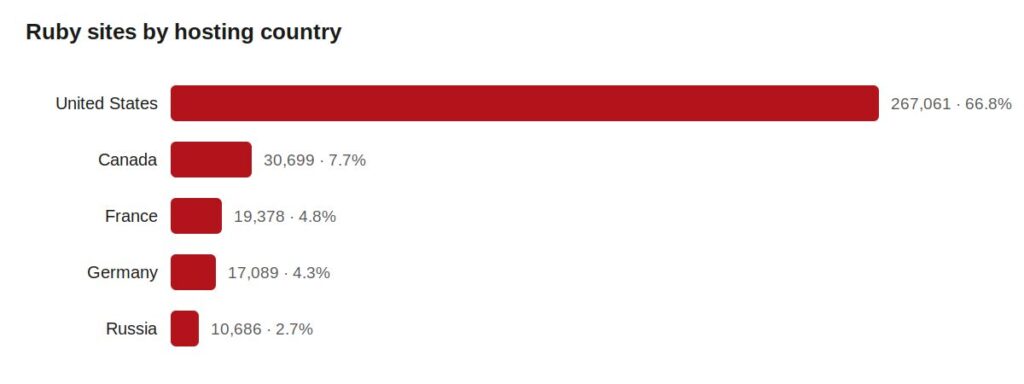
Ruby’s web footprint is heavily concentrated in North America. Two-thirds of detected sites resolve to US infrastructure, and adding Canada accounts for nearly three-quarters of the total.
| Country | Ruby sites | Share |
|---|---|---|
| United States | 267,061 | 66.8% |
| Canada | 30,699 | 7.7% |
| France | 19,378 | 4.8% |
| Germany | 17,089 | 4.3% |
| Russia | 10,686 | 2.7% |
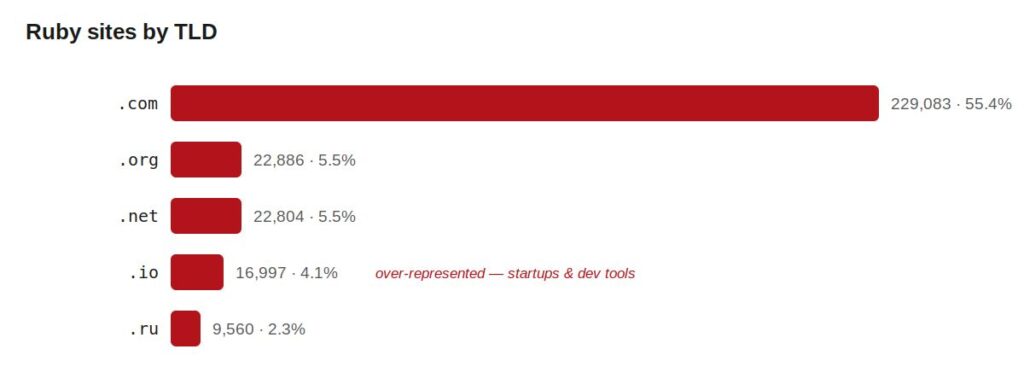
The TLD split tells a related story. .com dominates, as it does everywhere, but the standout is .io: at 4.1% of Ruby sites it’s far over-represented relative to its share of the web at large — a fingerprint of Ruby’s continued pull with startups and developer tools.
| TLD | Ruby sites | Share |
|---|---|---|
| .com | 229,083 | 55.4% |
| .org | 22,886 | 5.5% |
| .net | 22,804 | 5.5% |
| .io | 16,997 | 4.1% |
| .ru | 9,560 | 2.3% |
How this is measured — and how to pull it yourself
Every figure above comes from the same source: a daily crawl that records, per domain, which technologies are detectable, plus DNS records, WHOIS/RDAP, resolving IP, hosting country and a ranking signal. “Ruby” is one value in that technology column; filtering the dataset to it produces the 413,156-row list this article is built on. It’s re-detected and re-exported every day, so the population shifts as sites launch, lapse, or change what they expose.
If you want the underlying list rather than the summary — every detected Ruby domain with its hosting, country, TLD and rank, as structured JSON Lines — it’s published as a downloadable dataset, with a free sample to inspect the schema first. It’s a practical starting point for competitive research, for finding Rails shops by region, or for building your own “who runs Ruby” tooling on top of a maintained feed.
Frequently asked questions
How many websites are made with Ruby?
About 413,000 live sites currently expose a detectable Ruby signature — 413,156 in the July 2026 crawl, or roughly 0.1% of all indexed domains. Because backend languages are easy to hide, the real number is higher; this is a measured floor.
What famous websites are made with Ruby?
Airbnb, Dribbble, Gumroad and Goodreads still run detectable Ruby in production. GitHub, Shopify, Basecamp, Kickstarter, Twitch, Etsy and Zendesk are well-known Rails-built products, though a few early Rails sites (Twitter, Groupon) have since migrated parts of their stack.
Is Ruby still used for web development in 2026?
Yes. Its detectable web footprint is smaller than PHP, Python or Java but larger than Perl, and it stays over-represented among startups and developer tools — visible in the outsized .io share of Ruby domains.
How can I get a list of websites made with Ruby?
The complete detected list is available as a daily JSON Lines export, filterable by country and TLD, with each row carrying DNS, WHOIS, IP, hosting country and ranking alongside the domain. A free sample lets you check the format before committing.