

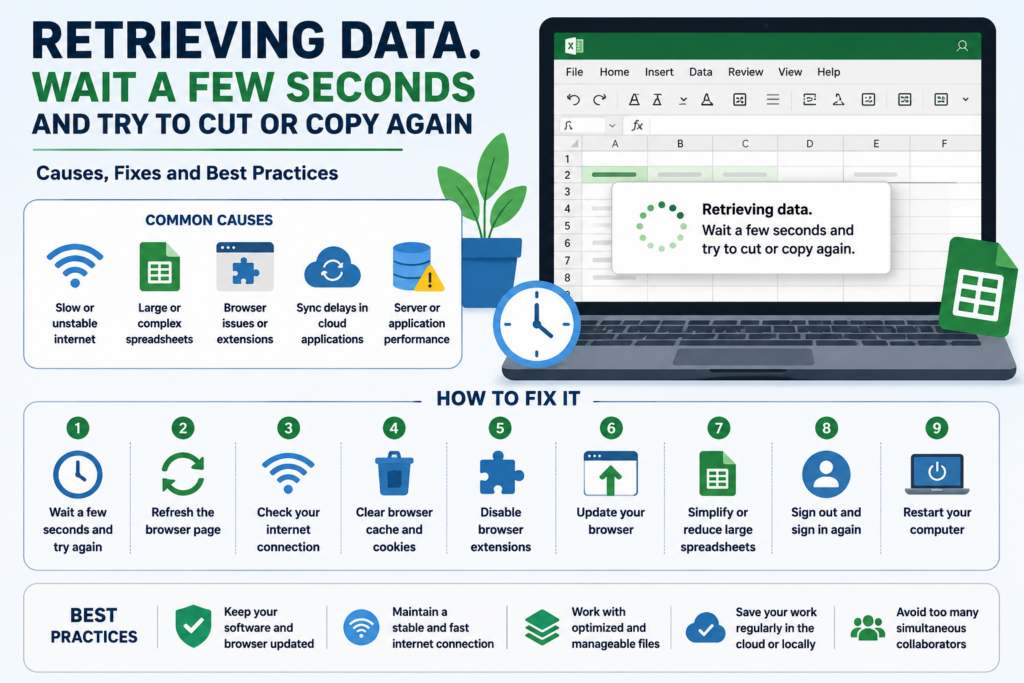
Seeing the message “retrieving data. wait a few seconds and try to cut or copy again” can be frustrating, especially when working in spreadsheets, cloud-based documents, or online collaboration tools. This error commonly appears when users attempt to cut, copy, or move information before the application finishes syncing or processing data in the background.
The issue is especially common in:
- Microsoft Excel Online
- Google Sheets
- Web-based spreadsheets
- Cloud document editors
- Shared collaboration platforms
In many cases, the error is temporary and can be resolved quickly with a few troubleshooting methods. However, repeated interruptions may indicate browser conflicts, synchronization problems, connectivity issues, or large dataset limitations.
This guide explains why retrieving data. wait a few seconds and try to cut or copy again appears, what causes it, and the best ways to fix the issue.
What Does “Retrieving Data. Wait a Few Seconds and Try to Cut or Copy Again” Mean?
This message usually appears when a cloud-based application has not fully processed or synchronized the requested data.
Modern web applications constantly:
- Sync information
- Save changes automatically
- Load remote data
- Communicate with servers
- Process large datasets
If you attempt to copy or move content before those tasks finish, the system may temporarily block the action.
In simple terms, the application needs more time to finish retrieving and processing the data.
Common Causes of the Error
Several factors can trigger retrieving data. wait a few seconds and try to cut or copy again.
Slow Internet Connection
Weak or unstable internet connectivity is one of the biggest causes.
Cloud-based applications rely heavily on:
- Real-time synchronization
- Server communication
- Online processing
If the connection slows down, data retrieval may become delayed.
Large Spreadsheets or Documents
Very large files require additional processing time.
Spreadsheets containing:
- Thousands of rows
- Complex formulas
- Pivot tables
- Macros
- Linked data sources
may trigger delays when copying information.
Browser Performance Problems
Browsers with:
- Too many tabs open
- High memory usage
- Outdated versions
- Problematic extensions
can struggle to process online spreadsheet operations efficiently.
Cached Browser Data
Corrupted cache files may interfere with cloud application performance.
Over time, cached:
- Cookies
- Scripts
- Temporary files
can create synchronization conflicts.
Application Sync Delays
Cloud applications constantly sync changes between:
- Local browsers
- Online servers
- Shared collaborators
Temporary sync interruptions can cause copy-and-paste operations to fail.
Wait a Few Seconds Before Trying Again
Sometimes the simplest solution works best.
If the message appears:
- Stop clicking repeatedly
- Wait several seconds
- Allow synchronization to finish
- Try copying again
Many temporary sync issues resolve automatically.
Refresh the Browser Page
Refreshing the browser often restores proper communication with cloud servers.
To refresh:
- Press F5
- Click the refresh button
- Reload the document
This forces the application to reload current data and synchronization status.
Check Your Internet Connection
A slow or unstable connection may interrupt cloud processing.
Test:
- Website loading speeds
- Streaming performance
- Other online services
If the connection is weak:
- Restart the router
- Reconnect Wi-Fi
- Switch networks if possible
Stable internet significantly improves cloud application reliability.
Use Desktop Applications Instead
Browser-based spreadsheet tools are convenient but sometimes less stable than desktop software.
If possible:
- Open the file in desktop Excel
- Use offline editing temporarily
- Save local copies
Desktop applications often handle large datasets more efficiently.
Clear Browser Cache and Cookies
Clearing cached data may fix corrupted synchronization files.
To clear browser cache:
- Open browser settings
- Select Privacy or History
- Clear cached files and cookies
- Restart the browser
This refreshes stored web application data.
Disable Browser Extensions
Some extensions interfere with web applications.
Potentially problematic extensions include:
- Ad blockers
- Security tools
- Clipboard managers
- Script blockers
Temporarily disable extensions and test the application again.
Update the Browser
Outdated browsers may struggle with modern cloud applications.
Update to the latest version of:
- Chrome
- Edge
- Firefox
- Safari
New updates often improve:
- Stability
- Memory management
- Compatibility
- Cloud synchronization
Reduce Spreadsheet Complexity
Large spreadsheets can overload browser memory and server processing.
To improve performance:
- Remove unnecessary formulas
- Delete unused formatting
- Split large sheets
- Reduce conditional formatting
- Limit volatile formulas
Simpler spreadsheets process faster.
Try Another Browser
Browser-specific compatibility issues occasionally trigger synchronization errors.
If the issue appears in one browser:
- Test another browser
- Compare performance
- Check extension conflicts
Some applications work more reliably in certain browsers.
Sign Out and Sign Back In
Account synchronization problems may interfere with online document processing.
Logging out and back in refreshes:
- Authentication tokens
- Cloud sessions
- Synchronization status
This sometimes resolves persistent errors.
Restart the Computer
Restarting your device refreshes:
- Browser processes
- Memory usage
- System resources
- Background applications
This can improve application performance significantly.
Why Cloud Applications Sometimes Struggle
Modern cloud productivity tools perform many operations simultaneously, including:
- Auto-saving
- Multi-user collaboration
- Formula calculations
- Real-time synchronization
- Remote server communication
When processing large or complex files, delays can occasionally occur.
Spreadsheet Performance and Data Analytics
Large spreadsheets are commonly used for:
- Reporting
- Business analytics
- Financial modeling
- Data visualization
- Dashboard creation
Professionals preparing for the Microsoft PL-300 test also work extensively with large datasets, reporting systems, and business intelligence tools where efficient data processing and analysis are critical, according to PrepAway.
How to Prevent the Error in the Future
To reduce the chance of seeing retrieving data. wait a few seconds and try to cut or copy again:
- Maintain stable internet access
- Keep browsers updated
- Reduce spreadsheet complexity
- Limit unnecessary extensions
- Use desktop apps for massive datasets
- Restart systems periodically
These steps improve overall application stability.
Common Applications Where the Error Appears
Users frequently encounter this issue in:
- Microsoft Excel Online
- Google Sheets
- SharePoint
- Office 365 web apps
- Cloud collaboration platforms
The exact wording may vary slightly depending on the application.
Does the Error Mean Data Loss?
Usually no.
Most of the time:
- Data remains safe
- Synchronization simply needs more time
- The operation can be retried successfully
However, saving your work regularly is still important.
Frequently Asked Questions
Why does retrieving data. wait a few seconds and try to cut or copy again appear?
It usually happens because the application has not finished syncing or processing data.
Can slow internet cause the error?
Yes. Weak internet connections are a major cause.
Does refreshing the browser help?
Often yes. Refreshing reloads synchronization and cloud communication.
Can browser extensions trigger the issue?
Absolutely. Some extensions interfere with cloud applications.
Is the issue related to large spreadsheets?
Very often. Complex or oversized files require more processing time.
Final Thoughts
The retrieving data. wait a few seconds and try to cut or copy again error is usually caused by temporary synchronization delays, browser conflicts, large spreadsheets, or unstable internet connections.
Fortunately, most cases can be resolved quickly by:
- Waiting briefly
- Refreshing the browser
- Clearing cache
- Updating software
- Improving internet stability
- Reducing spreadsheet complexity
As cloud-based productivity platforms continue evolving, proper browser maintenance, stable connectivity, and optimized files become increasingly important for smooth collaboration and reliable document performance.