
As organizations grow their cloud footprint, Terraform becomes the backbone for defining, versioning, and deploying infrastructure. Teams that start with a handful of modules and a single state file eventually find themselves managing dozens of accounts, hundreds of stacks, and thousands of individual resources. At that point, infrastructure-as-code stops being a best practice and becomes an operational necessity.
But scale introduces a problem that no amount of careful Terraform authoring can fully prevent: drift.
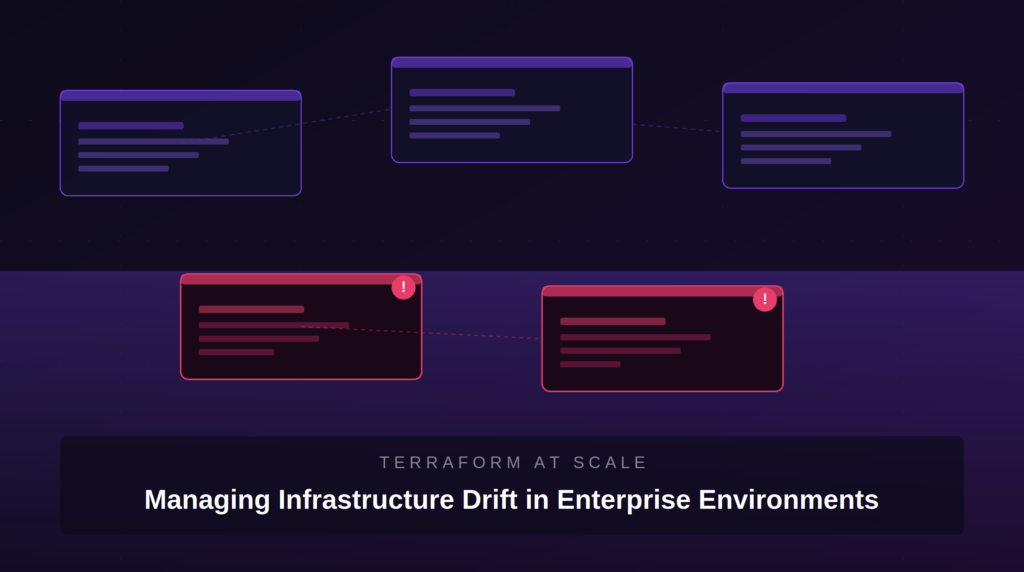
Drift is the gap between what your Terraform configuration says should exist and what is actually running in your cloud environment. It is quiet, cumulative, and at enterprise scale, genuinely dangerous.
Why Drift Is an Enterprise-Scale Problem
In small teams, drift is relatively easy to contain. There are a few contributors, a limited blast radius, and enough visibility that someone usually notices when a resource has been manually changed outside of a terraform apply cycle.
Enterprise environments break these assumptions. Incident responders make direct API calls to restore service, fully intending to clean it up in Terraform later, and often never doing so. Automated processes and third-party integrations modify resource attributes without going through any IaC workflow. Multiple teams apply changes across overlapping ownership boundaries with no single source of truth.
Multiply these vectors across dozens of environments, and drift stops being an edge case. It becomes the norm.
The four main categories to watch for are infrastructure drift (resources that differ from Terraform state), configuration drift (settings modified outside of code), policy and security drift (IAM rules and access controls that have diverged), and environment drift (inconsistencies between deployment tiers that erode confidence in your test environments).
The Limits of Standard Detection
The default Terraform approach to drift is terraform plan. At a small scale, this works fine. At enterprise scale, it has meaningful limitations.
terraform plan only knows about resources your configuration already manages. Anything provisioned directly through a cloud console is invisible to it. Running plans across hundreds of stacks simultaneously also requires significant orchestration, and without a platform designed for it, drift detection becomes a manual process that teams deprioritize under pressure.
This is why purpose-built infrastructure orchestration platforms have become essential for mature Terraform organizations. They provide continuous, automated detection across the full cloud inventory, not just the resources your state files know about, and surface results in a way operations teams can act on.
The Four Pillars of Enterprise Drift Management
Effective enterprise drift management relies on four capabilities working in a continuous loop.
Continuous detection means running scheduled scans that compare live infrastructure state against declared configuration, frequently enough to catch drift before it compounds, but lightweight enough not to overwhelm cloud provider API limits.
Precise analysis provides context alongside the technical description of what changed. Was there a recent deployment nearby? An incident response ticket? Is this resource frequently drifted, suggesting a systemic ownership problem? Root cause linkage is what separates operational drift management from simple state comparison.
Real-time alerting routes notifications to the right team with enough context to act without digging through logs. At enterprise scale, alert volume is a genuine challenge. Good alerting is configurable, with severity filters and routing rules that reflect actual operational priorities rather than firing on every changed tag.
Automated remediation with governance is the most powerful capability and the most important to implement carefully. The basic mechanism, automatically running terraform apply when drift is detected, removes dependency on human intervention. The governance layer is what makes it safe. Not all drift should be auto-fixed: an intentional hotfix applied during a production incident should not be silently reversed. Policy-as-code integration allows teams to automate the straightforward cases while protecting changes that require human judgment.
A detailed breakdown of how these pillars work in practice across large fleets, including scheduling, reconciliation governance, and operational considerations, is covered in this guide to enterprise drift management for large-scale environments.
Practices That Reduce Drift Frequency
Technology alone does not solve drift. Organizational habits matter just as much as tooling.
Restricting direct cloud access is the single most effective measure. When all changes must flow through an IaC workflow, the surface area for drift shrinks significantly. This requires making the IaC path easy enough that engineers do not feel compelled to bypass it during incidents.
When emergency direct changes are unavoidable, an explicit exception process for tracking and reconciling them prevents one-off fixes from silently becoming permanent drift. Integrating drift into incident response, routing alerts through on-call systems and including drift metrics in reliability reviews embeds it in operational culture rather than leaving it as a background concern that gets deprioritized.
Finally, tracking metrics like drift frequency and time to remediation over time creates the feedback loop needed to actually improve. Teams that measure drift manage it. Teams that do not are perpetually in reactive mode.
How Spacelift Handles Drift Detection and Remediation
Spacelift is an infrastructure orchestration platform that provides built-in drift detection and reconciliation for Terraform, OpenTofu, Pulumi, and CloudFormation. It runs periodic plan-based scans for each stack on a per-stack cron schedule, compares the live provider state against the declared configuration, and surfaces any differences in the web UI, alongside Slack, email, or webhook notifications.
When drift is found, Spacelift can automatically open a tracked reconciliation run to restore the correct state. These reconciliation runs follow the same policy rules as any other run on the platform, meaning teams can require manual approval before a remediation is applied, which is particularly useful in production environments or for any change that would destroy resources. Teams running at least daily drift checks on production stacks can pair this with Spacelift’s approval policies to get automated detection with human-gated remediation, without building any of that logic themselves.
Conclusion
Drift is not a bug in how Terraform works or a failure of engineering discipline. It is an emergent property of operating complex systems at scale. The organizations that manage it well are not the ones that eliminate it. They are the ones who build systematic, automated, governance-aware processes for continuously detecting and reconciling it. That operational maturity is what separates infrastructure teams that are constantly fighting fires from the ones that have time to build better platforms.