
The how to fix DNS server not responding error is one of the most common internet connectivity problems users experience on Windows computers and laptops. This issue prevents websites from loading properly because the device cannot communicate with the DNS server responsible for translating website names into IP addresses.
When the error appears, your internet may seem partially connected, but browsers fail to open websites. Many users mistakenly think the entire internet connection is broken, when in reality the problem often involves DNS configuration, network settings, routers, or ISP communication.
Fortunately, there are several proven methods that can resolve this issue quickly. This guide explains how to fix DNS server not responding errors using simple troubleshooting steps, advanced networking solutions, and long-term prevention methods.
What Does DNS Server Not Responding Mean?
Before learning how to fix DNS server not responding, it helps to understand what DNS actually does.
DNS stands for:
- Domain Name System
DNS servers convert human-readable website names like:
- google.com
- microsoft.com
- youtube.com
into numerical IP addresses computers use to communicate online.
If the DNS server stops responding:
- Websites cannot load
- Browsers display errors
- Internet access may appear broken
- Apps may fail to connect
Even though the device may still be connected to Wi-Fi, web traffic cannot route properly.
Common Causes of DNS Server Not Responding
Several issues can trigger this error.
Router Problems
Temporary router failures are one of the biggest causes of DNS errors.
Routers may experience:
- Overheating
- Software glitches
- Firmware bugs
- ISP communication failures
Restarting the router often fixes temporary DNS issues.
Incorrect DNS Settings
Improper DNS configurations may prevent successful internet communication.
This can happen after:
- Manual network changes
- VPN installation
- Malware removal
- ISP configuration issues
ISP DNS Server Failures
Sometimes the issue comes directly from your internet provider.
ISP DNS servers occasionally experience:
- Downtime
- Congestion
- Maintenance
- Technical failures
Switching to public DNS servers may solve the problem.
Network Driver Problems
Outdated or corrupted network drivers can interfere with internet communication.
This may cause:
- DNS lookup failures
- Slow browsing
- Connection interruptions
- Unstable networking
Firewall or Antivirus Conflicts
Security software can sometimes block DNS requests accidentally.
Certain antivirus or firewall configurations may interfere with:
- Browser traffic
- DNS resolution
- Network communication
Restart Your Router and Computer
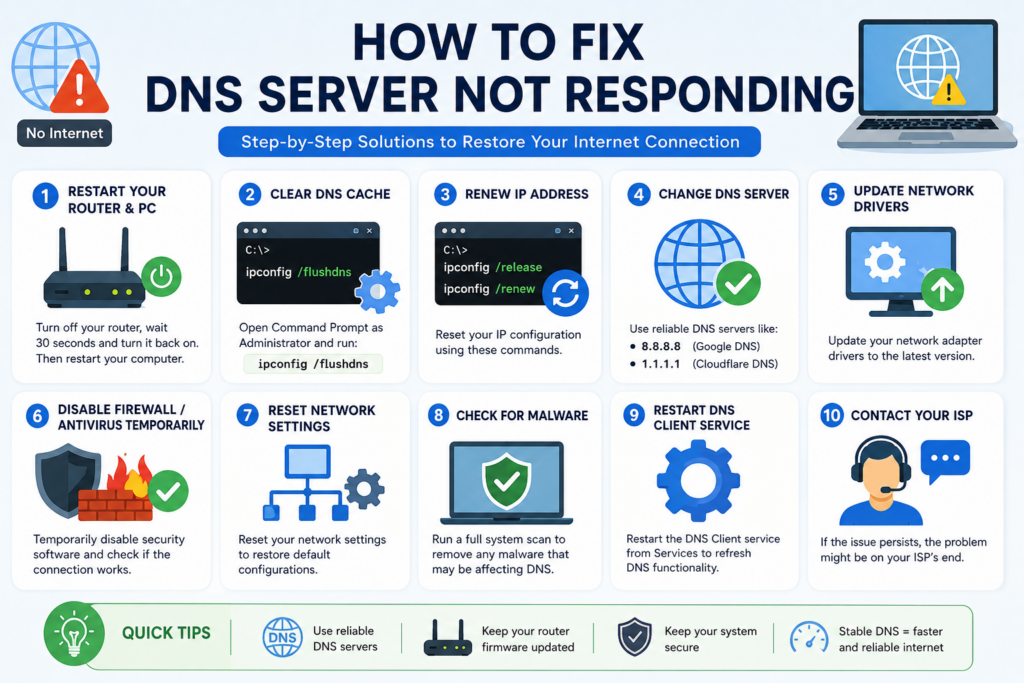
The first step in how to fix DNS server not responding is restarting your networking devices.
Restart the Router
- Turn off the router
- Wait 30 seconds
- Turn it back on
Allow the connection to fully restore.
Restart the Computer
Restarting refreshes:
- Network adapters
- Temporary configurations
- DNS cache
- Communication services
This simple fix often resolves temporary DNS failures.
Switch to a Different Browser
Sometimes the problem only affects one browser.
Try:
- Chrome
- Edge
- Firefox
- Safari
If websites work elsewhere, the issue may involve browser extensions or cached data.
Clear the DNS Cache
Windows stores DNS information locally to speed up browsing.
Corrupted DNS cache entries can trigger connectivity problems.
To clear DNS cache:
- Open Command Prompt as Administrator
- Type:
ipconfig /flushdns
- Press Enter
This refreshes stored DNS information.
Reset the IP Address
Refreshing your IP configuration can help restore proper communication.
Use these commands in Command Prompt:
ipconfig /release
ipconfig /renew
These commands reset network communication with the router.
Change DNS Server Settings
One of the best solutions for how to fix DNS server not responding is switching to public DNS providers.
Popular DNS servers include:
Google DNS
- 8.8.8.8
- 8.8.4.4
Cloudflare DNS
- 1.1.1.1
- 1.0.0.1
Public DNS servers are often:
- Faster
- More reliable
- More stable than ISP DNS systems
How to Change DNS Settings on Windows
Step 1
Open:
- Control Panel
- Network and Sharing Center
Step 2
Select:
- Change adapter settings
Step 3
Right-click your active connection and choose:
- Properties
Step 4
Select:
- Internet Protocol Version 4 (TCP/IPv4)
Click:
- Properties
Step 5
Choose:
- Use the following DNS server addresses
Enter:
- Preferred DNS: 8.8.8.8
- Alternate DNS: 8.8.4.4
Save the changes and restart the connection.
Disable Antivirus Temporarily
Security software occasionally blocks DNS traffic incorrectly.
Temporarily disable:
- Antivirus software
- Firewall protection
- Network filtering tools
Then test the connection again.
If the internet works afterward, the security configuration may need adjustment.
Update Network Drivers
Outdated drivers are another common cause of DNS issues.
To update drivers:
- Open Device Manager
- Expand Network Adapters
- Right-click your adapter
- Select Update Driver
Updated drivers improve:
- Stability
- Compatibility
- Networking performance
Reset Network Settings
Corrupted network configurations can prevent DNS communication.
Resetting network settings restores default configurations.
On Windows:
- Open Settings
- Go to Network & Internet
- Select Advanced Network Settings
- Choose Network Reset
After restarting, reconnect to Wi-Fi.
Boot Windows in Safe Mode
Safe Mode loads minimal drivers and services.
If DNS works in Safe Mode, the problem may involve:
- Third-party software
- Startup applications
- Security tools
- Network conflicts
This helps isolate the issue.
Disable IPv6
Some networks experience DNS conflicts with IPv6 enabled.
To disable IPv6:
- Open Network Connections
- Select your network adapter
- Open Properties
- Uncheck:
- Internet Protocol Version 6 (TCP/IPv6)
Then reconnect and test the internet.
Check for Malware
Malware can modify:
- DNS settings
- Browser traffic
- Network communication
Run a full malware scan using trusted security software.
Restart the DNS Client Service
Windows uses a DNS Client service to manage DNS requests.
To restart it:
- Press Windows + R
- Type:
services.msc - Locate:
- DNS Client
- Restart the service
This may restore proper DNS functionality.
Why DNS Is Important for the Internet
Without DNS:
- Websites would not load properly
- Browsers could not locate servers
- Internet navigation would become extremely difficult
DNS acts like the internet’s phonebook by translating names into machine-readable addresses.
How Businesses Handle DNS Reliability
Large organizations rely heavily on stable DNS infrastructure for:
- Websites
- Cloud applications
- Internal services
- Security systems
- Enterprise communication
Professionals preparing for the Microsoft AZ-800 certification also study Windows Server networking, DNS services, hybrid infrastructure, and enterprise network administration concepts used in business environments, says Testkings.com.
How to Prevent DNS Problems
To reduce future DNS issues:
- Restart routers occasionally
- Keep drivers updated
- Use reliable DNS providers
- Avoid suspicious software
- Maintain updated firmware
- Monitor network security
Stable networking environments improve DNS reliability significantly.
Common DNS Error Variations
Users may also encounter related messages like:
- DNS probe finished no internet
- DNS address could not be found
- Server DNS address could not be found
- DNS lookup failed
- Unable to resolve DNS
Most are related to similar networking issues.
Frequently Asked Questions
Can restarting the router fix DNS problems?
Yes. Router restarts often resolve temporary DNS communication failures.
Is DNS related to internet speed?
Indirectly yes. Faster DNS servers can improve website loading times.
Can VPNs cause DNS problems?
Yes. VPN software may interfere with DNS routing and communication.
Is Google DNS safe?
Yes. Google DNS is widely used and considered reliable.
Does malware affect DNS settings?
Absolutely. Some malware modifies DNS configurations maliciously.
Final Thoughts
Understanding how to fix DNS server not responding errors can save time and frustration when internet connectivity problems appear unexpectedly.
In most cases, DNS issues are caused by:
- Router glitches
- Incorrect settings
- ISP DNS failures
- Driver problems
- Security software conflicts
Fortunately, solutions like restarting devices, clearing DNS cache, updating drivers, switching DNS servers, and resetting network settings often restore internet access quickly.
Maintaining stable networking configurations and using reliable DNS providers can also help prevent future DNS-related problems and improve overall browsing performance.