

Cryptocurrency payments have evolved far beyond simply sharing a static wallet address. Modern systems rely on crypto payment APIs that automate the entire payment lifecycle — from generating unique addresses to confirming transactions in real time — all while maintaining a non-custodial structure.
This article breaks down how these APIs work under the hood, focusing on address generation, transaction tracking, and secure, non-custodial payment processing.
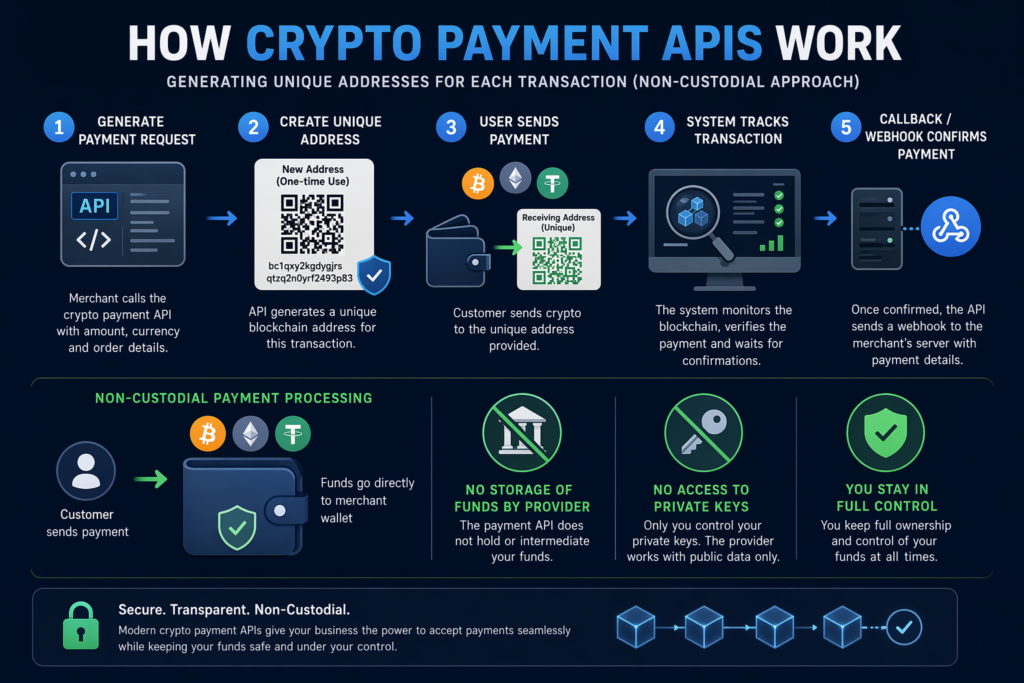
The Basic Payment Flow
At a high level, crypto payment APIs follow a structured sequence:
- Generate payment request
- Create a unique address
- User sends payment
- System tracks the transaction
- Callback/webhook confirms payment
Each step is automated and programmatically controlled, allowing businesses to accept crypto payments without manual intervention.
1. Generating a Payment Request
When a customer initiates a payment (e.g., at checkout), the merchant’s backend calls a crypto payment API to create a new payment request.
This request typically includes:
- Payment amount
- Currency (BTC, ETH, USDT, etc.)
- Optional metadata (order ID, customer reference)
The API responds with a dedicated payment address tied to that specific transaction.
2. Creating a Unique Address Per Transaction
Instead of reusing a single wallet address, modern systems generate a unique blockchain address for every payment.
Why this matters:
- Accurate tracking: Each address maps to one transaction
- No ambiguity: Eliminates the need to match amounts manually
- Improved privacy: Prevents address reuse on public blockchains
How it works technically:
- The API derives new addresses from a master public key (via HD wallets)
- No private keys are exposed or shared
- Address generation is deterministic but secure
This approach allows businesses to scale payments while maintaining clean accounting and traceability.
3. User Sends the Payment
Once the address is generated:
- The user sends crypto to that address
- The transaction is broadcast to the blockchain
- The network begins confirming it
At this stage, the system does not yet consider the payment final — it must be verified.
4. Tracking Transactions Programmatically
The API continuously monitors the blockchain for incoming transactions linked to generated addresses.
This is done through:
- Blockchain node connections
- Indexing services
- Transaction listeners
The system checks:
- Whether funds arrived at the correct address
- Whether the amount matches the request
- How many confirmations the transaction has
Because each address is unique, the system can instantly associate a payment with a specific order.
5. Callback / Webhook Confirmation
Once the transaction meets predefined conditions (e.g., sufficient confirmations), the API sends a webhook (callback) to the merchant’s server.
This webhook typically includes:
- Transaction ID (TXID)
- Amount received
- Confirmation status
- Associated order ID
The merchant system can then:
- Mark the order as paid
- Trigger fulfillment (e.g., shipping, account activation)
- Update internal records
This automation removes the need for manual verification.
Non-Custodial Payment Processing
A key advantage of modern crypto payment APIs is their non-custodial design.
What this means:
- Funds go directly to the merchant’s wallet
Payments are sent straight to addresses controlled by the merchant. - No storage of funds by the provider
The API provider never holds or intermediates the funds. - No access to private keys
Only the merchant controls private keys — the provider works with public data only.
Why this is important:
- Security: Eliminates third-party custody risks
- Control: Merchants retain full ownership of funds
- Compliance simplicity: Reduces regulatory burden in many cases
In contrast to custodial systems (where funds pass through an intermediary), non-custodial infrastructure aligns with the core principles of blockchain: decentralization and self-custody.
Bringing It All Together
A crypto payment API essentially acts as an automation layer between your business and the blockchain. It:
- Generates unique payment addresses for each transaction
- Tracks blockchain activity in real time
- Confirms payments via webhooks
- Ensures funds flow directly to your wallet
Final Thoughts
The shift toward unique address generation and non-custodial processing is what makes modern crypto payments scalable and secure. By combining deterministic address creation with automated transaction tracking, crypto payment APIs enable businesses to accept digital assets with the same ease as traditional payment systems — but without sacrificing control over funds.
As adoption grows, understanding these mechanics becomes essential for any business looking to integrate crypto payments effectively.