
Preparing for DevOps interview questions can feel overwhelming because DevOps combines multiple disciplines into a single role. Modern DevOps professionals are expected to understand software development, cloud infrastructure, automation, CI/CD pipelines, monitoring, security, containers, scripting, and system reliability.
Whether you are applying for a junior DevOps engineer position or a senior cloud automation role, interviewers often test both technical knowledge and practical problem-solving ability. Companies want candidates who can improve deployment speed, automate infrastructure, reduce downtime, and support scalable development workflows.
This in-depth guide covers the most common DevOps interview questions, explains how to answer them, and highlights important concepts frequently discussed during technical interviews.
What Is DevOps?
Before diving into DevOps interview questions, it’s important to understand what DevOps actually means.
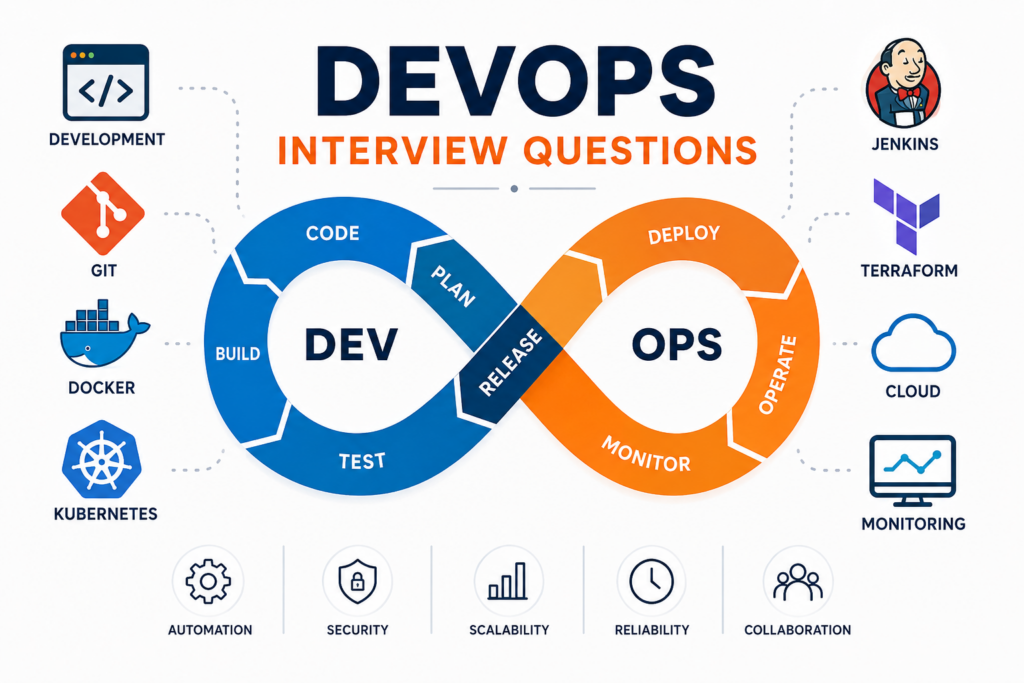
DevOps is a combination of:
- Development (Dev)
- Operations (Ops)
It focuses on improving collaboration between software developers and IT operations teams.
The primary goals of DevOps include:
- Faster software delivery
- Automation
- Continuous integration
- Continuous deployment
- Improved reliability
- Better scalability
- Reduced deployment failures
DevOps encourages organizations to automate infrastructure, testing, monitoring, and deployment processes.
Basic DevOps Interview Questions
These questions are commonly asked in entry-level interviews.
What Is DevOps?
A strong answer should explain:
- Collaboration between development and operations
- Automation of workflows
- Faster software releases
- Continuous integration and delivery
- Improved software reliability
Example answer:
DevOps is a methodology that combines development and IT operations practices to improve software delivery speed, automation, collaboration, and system reliability through continuous integration and deployment processes.
What Are the Main Benefits of DevOps?
Key points include:
- Faster deployments
- Better collaboration
- Reduced downtime
- Automation
- Improved scalability
- Faster issue resolution
- Continuous delivery
Interviewers want to see understanding of business benefits as well as technical advantages.
What Is CI/CD?
CI/CD stands for:
- Continuous Integration
- Continuous Continuous Deployment or Delivery
Continuous Integration
Developers frequently merge code into shared repositories where automated testing validates changes.
Continuous Delivery
Applications remain deployment-ready at all times.
Continuous Deployment
Code changes are automatically released to production after passing tests.
CI/CD is one of the most common topics in DevOps interview questions.
Difference Between Continuous Delivery and Continuous Deployment
This is a very common interview question.
Continuous Delivery
- Deployment requires manual approval
Continuous Deployment
- Deployments happen automatically without manual intervention
Understanding this distinction is important.
Linux DevOps Interview Questions
Linux knowledge is essential for most DevOps roles.
What Is the Difference Between Linux and Unix?
A simplified answer:
- Unix is the original operating system family
- Linux is an open-source Unix-like operating system
Many DevOps environments rely heavily on Linux servers.
Common Linux Commands DevOps Engineers Use
Interviewers may ask about:
- ls
- cd
- grep
- chmod
- chown
- top
- ps
- netstat
- curl
- find
- systemctl
You should understand both syntax and practical usage.
How Do You Check Running Processes in Linux?
Typical answers include:
- ps
- top
- htop
You may also explain how to:
- Kill processes
- Monitor CPU usage
- Analyze memory consumption
Git and Version Control Interview Questions
Git is foundational in DevOps workflows.
What Is Git?
Git is a distributed version control system used to track source code changes and enable team collaboration.
Difference Between Git Fetch and Git Pull
Git Fetch
Downloads changes without merging them.
Git Pull
Downloads and merges changes automatically.
What Is a Merge Conflict?
A merge conflict occurs when multiple developers modify the same section of code and Git cannot automatically resolve the differences.
Interviewers often ask how you handle conflicts professionally.
Docker DevOps Interview Questions
Docker is one of the most important DevOps technologies today.
What Is Docker?
Docker is a containerization platform that packages applications and dependencies into lightweight portable containers.
Containers ensure applications run consistently across environments.
Difference Between Containers and Virtual Machines
Containers
- Lightweight
- Share host OS kernel
- Faster startup
- Lower resource usage
Virtual Machines
- Include full operating systems
- Higher resource consumption
- Slower boot times
This is one of the most common DevOps interview questions.
What Is a Docker Image?
A Docker image is a read-only template used to create containers.
Images contain:
- Application code
- Dependencies
- Runtime environment
- System libraries
What Is Docker Compose?
Docker Compose manages multi-container applications using YAML configuration files.
It simplifies launching:
- Databases
- APIs
- Web servers
- Supporting services
Kubernetes Interview Questions
Kubernetes frequently appears in modern DevOps interview questions.
What Is Kubernetes?
Kubernetes is a container orchestration platform used to automate:
- Deployment
- Scaling
- Management
- Monitoring of containerized applications
What Is a Pod in Kubernetes?
A Pod is the smallest deployable unit in Kubernetes.
It can contain:
- One container
- Multiple tightly coupled containers
What Is a Deployment in Kubernetes?
A Deployment manages:
- Pod replicas
- Scaling
- Updates
- Rollbacks
It ensures application availability and desired state management.
What Is Auto Scaling?
Auto scaling automatically increases or decreases infrastructure resources based on:
- CPU usage
- Memory usage
- Traffic load
- Performance metrics
This improves cost efficiency and scalability.
Cloud DevOps Interview Questions
Cloud computing knowledge is now critical for DevOps engineers.
What Is Infrastructure as Code?
Infrastructure as Code (IaC) automates infrastructure provisioning using configuration files instead of manual setup.
Popular IaC tools include:
- Terraform
- CloudFormation
- Ansible
What Is Terraform?
Terraform is an Infrastructure as Code tool that automates:
- Cloud infrastructure provisioning
- Resource management
- Configuration deployment
It supports multi-cloud environments.
Difference Between Terraform and Ansible
Terraform
- Infrastructure provisioning
- Declarative
- Cloud resource management
Ansible
- Configuration management
- Application deployment
- Server automation
Interviewers often compare these tools.
What Is Serverless Computing?
Serverless computing allows developers to run applications without managing servers directly.
Examples include:
- AWS Lambda
- Azure Functions
- Google Cloud Functions
Professionals studying for the Microsoft AZ-204 certification also work with Azure Functions and cloud-based application development concepts commonly discussed in DevOps environments, says Test-Inside.com.
Jenkins DevOps Interview Questions
Jenkins remains a major CI/CD tool.
What Is Jenkins?
Jenkins is an open-source automation server used for:
- Continuous integration
- Continuous delivery
- Build automation
- Deployment pipelines
What Is a Jenkins Pipeline?
A Jenkins Pipeline defines automated CI/CD workflows.
Pipelines typically include:
- Code checkout
- Build processes
- Testing
- Deployment
- Notifications
Difference Between Declarative and Scripted Pipelines
Declarative Pipeline
- Simpler syntax
- Structured format
- Easier maintenance
Scripted Pipeline
- More flexible
- Uses Groovy scripting
- Better for advanced workflows
Monitoring and Logging Interview Questions
Monitoring is a critical DevOps responsibility.
Why Is Monitoring Important?
Monitoring helps:
- Detect failures
- Improve uptime
- Track performance
- Reduce downtime
- Identify bottlenecks
Popular Monitoring Tools
Common tools include:
- Prometheus
- Grafana
- ELK Stack
- Datadog
- New Relic
- Splunk
You should understand what these tools actually monitor.
What Is the ELK Stack?
ELK stands for:
- Elasticsearch
- Logstash
- Kibana
It is widely used for centralized logging and log analysis.
Security DevOps Interview Questions
DevSecOps topics appear frequently today.
What Is DevSecOps?
DevSecOps integrates security into the DevOps lifecycle.
Security becomes part of:
- CI/CD pipelines
- Development
- Testing
- Deployment
- Monitoring
Why Is Security Important in DevOps?
Fast deployments can create vulnerabilities if security is ignored.
Modern DevOps teams automate:
- Vulnerability scanning
- Secrets management
- Compliance checks
- Access control
Scenario-Based DevOps Interview Questions
Many companies use practical problem-solving questions.
How Would You Handle a Failed Deployment?
A strong answer may include:
- Rollback procedures
- Log analysis
- Monitoring alerts
- Root cause analysis
- Testing validation
- Communication with stakeholders
Interviewers want structured troubleshooting approaches.
How Would You Reduce Deployment Downtime?
Common solutions include:
- Blue-green deployments
- Canary releases
- Load balancing
- Auto scaling
- Rolling updates
How Would You Improve CI/CD Performance?
Potential answers:
- Parallel builds
- Build caching
- Container optimization
- Faster test execution
- Incremental deployments
Behavioral DevOps Interview Questions
Soft skills matter heavily in DevOps roles.
How Do You Handle Production Pressure?
Interviewers want evidence of:
- Calm troubleshooting
- Communication skills
- Incident management
- Team collaboration
Describe a Difficult Technical Problem You Solved
Use structured answers:
- Situation
- Problem
- Actions taken
- Results achieved
This demonstrates analytical thinking.
Tips for Passing DevOps Interviews
To perform well:
- Practice Linux commands
- Learn CI/CD pipelines
- Understand containers
- Study cloud basics
- Build hands-on projects
- Learn Git workflows
- Practice troubleshooting
- Understand automation concepts
Hands-on experience matters far more than memorization.
Most Important DevOps Tools to Learn
Interviewers frequently ask about:
- Docker
- Kubernetes
- Jenkins
- Terraform
- Git
- Ansible
- Prometheus
- Grafana
- AWS
- Azure
- Linux
You do not need mastery of every tool, but broad familiarity helps.
Common Mistakes During DevOps Interviews
Avoid:
- Giving overly theoretical answers
- Ignoring practical examples
- Memorizing definitions only
- Lacking troubleshooting knowledge
- Not understanding cloud concepts
- Overstating experience
Interviewers value practical understanding.
Best Way to Prepare for DevOps Interview Questions
The strongest preparation includes:
- Building projects
- Creating CI/CD pipelines
- Using Docker and Kubernetes
- Practicing Linux commands
- Deploying applications to cloud platforms
- Automating infrastructure
Practical skills stand out immediately during technical interviews.
Final Thoughts
Preparing for DevOps interview questions requires understanding a wide range of technologies, workflows, and automation practices.
Modern DevOps professionals are expected to combine:
- Development knowledge
- Infrastructure management
- Cloud computing
- Automation
- Monitoring
- Security
- Troubleshooting
Although the field can seem overwhelming at first, focusing on core concepts like Linux, Git, CI/CD, containers, cloud services, and Infrastructure as Code builds a strong foundation for most DevOps roles.
The best way to succeed in DevOps interviews is through hands-on practice, real-world projects, and a solid understanding of how modern software delivery systems work in production environments.