
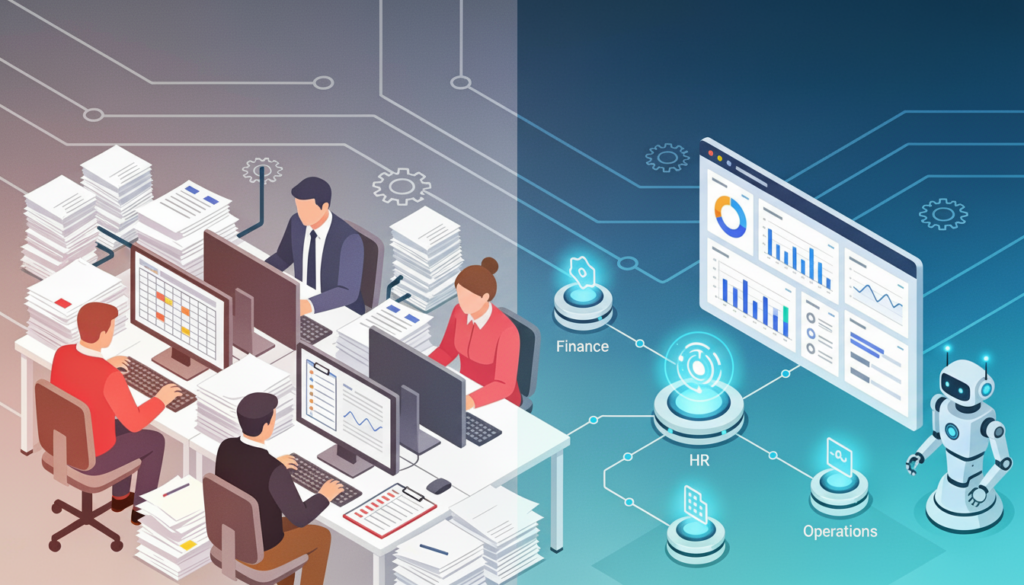
Despite decades of investment in ERP platforms, workflow engines, and automation tools, manual work remains deeply embedded in enterprise operations. Employees still reconcile data between systems, interpret unstructured inputs, validate exceptions, and act as human intermediaries between digital tools that were never designed to reason—only to execute predefined logic. This persistence of manual effort is not a failure of digitization, but a structural limitation of traditional automation models.
Most operational inefficiencies do not originate inside systems; they emerge in the spaces between them. Manual work thrives in handoffs, edge cases, and judgment-heavy moments where rule-based automation collapses under real-world variability. As organizations scale, these friction points multiply, creating invisible operational drag that slows execution and increases risk. This is where AI-driven automation fundamentally changes the equation.
Enterprises increasingly partner with an artificial intelligence software development company not to replace existing systems, but to introduce intelligence into the connective tissue of operations. AI-driven automation enables systems to interpret context, learn from historical behavior, and adapt to non-deterministic scenarios—capabilities that dramatically reduce the need for human intervention in routine yet complex work.
What is often overlooked is that enterprises already possess the data needed to automate more intelligently. The constraint is no longer data availability, but the ability to operationalize it. Modern enterprise AI architectures emphasize this shift: data becomes an active participant in operations, not a passive resource for reporting. This transition marks the real beginning of scalable, sustainable automation.
From Rule-Based Automation to AI-Driven Systems
Traditional automation operates on certainty. Rules must be defined, conditions anticipated, and outcomes explicitly programmed. This approach works well for stable, repetitive processes but breaks down as soon as variability enters the system—an inevitability in modern enterprises operating across markets, regulations, and customer channels.
AI-driven automation introduces a probabilistic model of execution. Instead of encoding every scenario, AI systems learn from patterns in historical data, interpret unstructured inputs, and make context-aware decisions when rules alone are insufficient. This shift is less about replacing workflows and more about augmenting them with adaptive intelligence.
A rarely discussed benefit of this transition is complexity containment. In rule-based systems, complexity accumulates externally in the form of exceptions, workarounds, and conditional logic. Over time, automation becomes harder to maintain than the manual process it was meant to replace. AI-driven systems absorb complexity internally, refining behavior as conditions change rather than exposing it to developers and operators.
Governance also evolves. Instead of approving logic upfront, enterprises oversee outcomes, monitor performance, and intervene only when necessary. Automation becomes a living capability, not a static configuration.
Where Manual Work Persists Most in Enterprise Operations
Manual work survives in enterprises because complexity concentrates in predictable but poorly addressed areas. The most common is system interaction. Even highly digitized organizations rely on humans to bridge gaps between CRM, ERP, analytics, and industry-specific platforms.
Exception handling is another major source of manual effort. Processes are designed for ideal conditions, yet reality constantly deviates—documents don’t match, data conflicts, and inputs arrive incomplete. Humans step in not because the process is undefined, but because interpretation is required. AI-driven automation learns from how exceptions are historically resolved, gradually reducing the need for human escalation.
Knowledge-intensive processes are often assumed to be non-automatable. Compliance reviews, approvals, and operational decisions depend on experience rather than rules. In practice, these decisions follow patterns that AI can model, support, and partially automate without removing accountability.
Perhaps the most expensive manual activity is data preparation. Highly skilled professionals spend disproportionate time gathering and cleaning data instead of acting on it. AI-driven automation shifts effort upstream, continuously preparing data so humans focus on judgment, not assembly.
Core Enterprise Use Cases for AI-Driven Automation
AI-driven automation delivers the greatest impact when applied to operational friction rather than isolated tasks. High-value use cases typically combine data variability, decision-making, and scale.
| Use Case Area | Manual Work Reduced | AI Contribution |
| Document-heavy operations | Extraction, validation, routing | NLP-based understanding of unstructured content |
| Process orchestration | Task routing, prioritization | Predictive flow optimization |
| Operational monitoring | Incident detection, triage | Pattern recognition and anomaly prediction |
| Decision support | Data synthesis | Context-aware recommendations |
An underappreciated effect is compounding value. Reducing manual work in one layer increases predictability downstream, enabling further automation. Intelligence creates scale, and scale improves intelligence.
For deeper architectural perspectives, trusted resources such as the IEEE Computer Society and Gartner’s enterprise AI research consistently highlight the importance of intelligence-first automation strategies.
Architectural Considerations for Building AI-Driven Automation
AI-driven automation succeeds or fails at the architectural level. Treating AI as an add-on rather than a foundational capability leads to fragile implementations with limited impact.
Data readiness is the primary constraint. AI depends not just on data volume, but on consistency, lineage, and semantic alignment across domains. Enterprises frequently underestimate the architectural effort required before intelligence can be operationalized.
Integration strategy is equally critical. AI should act as an intelligence layer that interfaces with core systems through APIs and events, allowing automation logic to evolve independently of transactional platforms.
Feedback architecture is often ignored. Without structured feedback loops, AI systems cannot learn from outcomes or corrections. Automation stagnates, losing relevance over time. Continuous learning is not optional—it is the defining feature of AI-driven systems.
Measuring Impact: Beyond Cost and Headcount Reduction
Traditional ROI metrics fail to capture the real value of AI-driven automation. The most significant gains appear in resilience, decision quality, and responsiveness.
AI reduces error propagation by detecting inconsistencies early. It stabilizes operations under stress, making performance more predictable. These benefits rarely appear in cost models but directly influence enterprise risk and reliability.
Another overlooked metric is decision latency—the time between signal and action. Reducing this gap improves customer experience, compliance response, and competitive agility.
Common Pitfalls That Undermine AI Automation Initiatives
Many initiatives fail due to strategic misalignment rather than technical limitations. Treating AI as a tool instead of an operational capability results in disconnected pilots with no systemic value.
Automating inefficient processes is another frequent mistake. AI amplifies whatever it touches. Without process redesign, automation scales inefficiency.
Finally, trust is often neglected. Without transparency, explainability, and human oversight, employees bypass AI systems, quietly reintroducing manual work.
The Strategic Role of Software Development Partners
AI-driven automation rarely succeeds as a generic implementation. Enterprises need partners who understand both software architecture and operational reality.
Custom development ensures AI aligns with business logic, governance models, and risk thresholds. More importantly, it enables automation systems to evolve alongside strategy, rather than becoming technical debt.
This is what transforms AI from experimentation into operational infrastructure.
The Future of Enterprise Operations in an AI-Automated World
Enterprise operations are moving toward systems that actively participate in decision-making. AI-driven automation enables semi-autonomous operations that self-optimize and escalate only when human judgment is essential.
This shift will redefine enterprise software strategy. Platforms will be evaluated not by features, but by how effectively they integrate intelligence. Organizations that invest early will not just reduce manual work—they will redefine how work flows.