
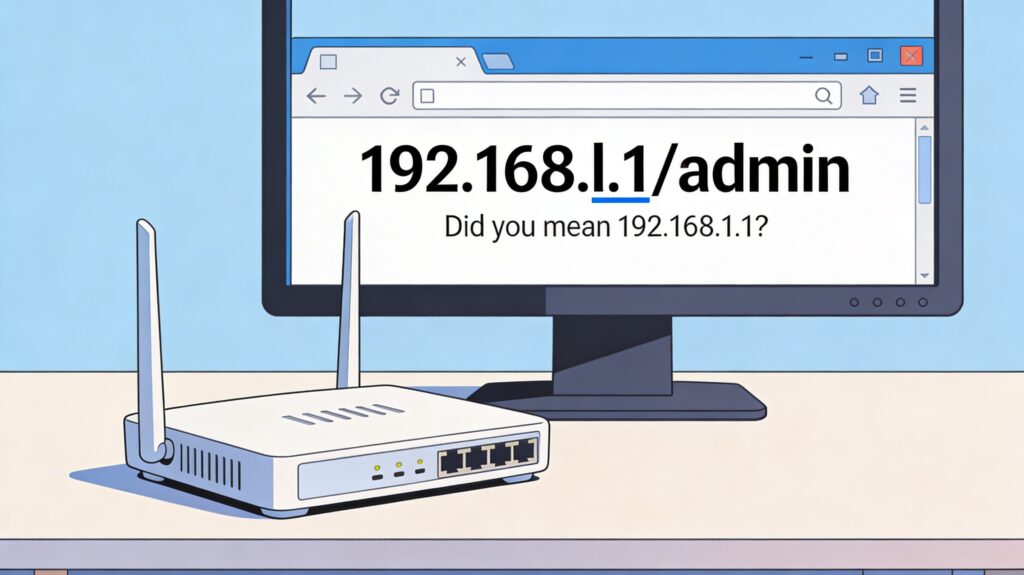
If you’ve typed 192.168.l.1/admin into your browser and ended up confused, you’re not alone. This is one of the most common router login mistakes online.
The issue?
You’ve used a lowercase “L” (l) instead of the number “1”.
The correct address is:
http://192.168.1.1
That single character makes all the difference.
In this guide, I’ll explain:
- Why 192.168.l.1 doesn’t work
- What 192.168.1.1 actually is
- How to log into your router properly
- What to do if 192.168.1.1 doesn’t open
- Default router usernames and passwords
Let’s fix it.
Why 192.168.l.1 Doesn’t Work
IP addresses only use numbers, not letters.
192.168.l.1 is invalid because:
- The “l” is a letter
- IP addresses only contain numbers from 0–255
- Your browser doesn’t recognise it as a valid local address
So if you typed:
192.168.l.1/admin
You simply need to replace the l with 1.
Correct version:
192.168.1.1
And you don’t usually need /admin at the end.
What Is 192.168.1.1?
192.168.1.1 is a private IP address used by many routers as their default gateway. 192.168.l.1/admin is a typo!
Popular router brands that commonly use this address include:
When you enter 192.168.1.1 into your browser, you’re accessing your router’s admin panel — the control centre for your WiFi network.
How to Log Into Your Router (Step-by-Step)
Step 1: Connect to Your Network
Make sure you are connected to your router:
- Via WiFi
- Or with an Ethernet cable
You must be on the same network for 192.168.1.1 to work.
Step 2: Open a Web Browser
Use Chrome, Edge, Safari, or Firefox.
In the address bar (not Google search), type:
http://192.168.1.1
Press Enter.
Step 3: Enter Login Credentials
You’ll see a login page asking for:
- Username
- Password
If you’ve never changed them, check the sticker on the bottom or back of your router.
Common defaults are:
| Username | Password |
|---|---|
| admin | admin |
| admin | password |
| admin | (blank) |
⚠️ If these don’t work, someone may have changed the login details.
What If 192.168.1.1 Doesn’t Open?
Don’t panic — there are a few possible reasons.
1. Your Router Uses a Different IP
Some routers use:
- 192.168.0.1
- 192.168.1.254
- 10.0.0.1
To find your router’s correct address:
On Windows:
- Press Windows + R
- Type
cmd - Enter
ipconfig - Look for Default Gateway
That number is your router’s login IP.
2. You’re Not Connected to the Router
If you’re using mobile data or a different WiFi network, 192.168.1.1 won’t load.
Make sure you’re connected to your home network.
3. The Router Needs Restarting
If the page times out:
- Turn the router off
- Wait 30 seconds
- Turn it back on
- Try again
What Can You Change Inside 192.168.1.1?
Once logged in, you can:
- Change your WiFi name (SSID)
- Update your WiFi password
- Set parental controls
- Configure port forwarding
- Change DNS settings
- Update firmware
- See connected devices
- Improve network security
Be careful when changing advanced settings unless you know what they do.
Forgot Your Router Password?
If you can’t log in and don’t know the password:
Option 1: Try Default Credentials
Check the router label first.
Option 2: Factory Reset
- Find the small reset hole on the router
- Press and hold with a pin for 10–15 seconds
- Wait for the router to restart
⚠️ This will erase:
- Custom WiFi name
- WiFi password
- Any special settings
After reset, use the default login details.
Security Tip (Very Important)
If your router is still using:
Username: admin
Password: admin
Change it immediately.
Leaving default login details makes your network vulnerable.
Choose:
- A strong admin password
- WPA3 or WPA2 security
- A unique WiFi password
Quick Summary
If you searched for:
192.168.l.1/admin
The fix is simple:
✔ Replace the letter l with the number 1 (it shouldn’t be 192.168.l.1/admin)
✔ Use http://192.168.1.1
✔ Log in using your router credentials
✔ Check your default gateway if it doesn’t work
That tiny typo causes thousands of login issues every day.
Now you know how to access your router properly and manage your network settings with confidence.